
Keeps the seal tight over time
RPTFE slowly creeps under constant load and does not spring back like rubber. The O-ring takes up that relaxation, so the contact pressure on the seat holds.
Triple Offset Seat Seals
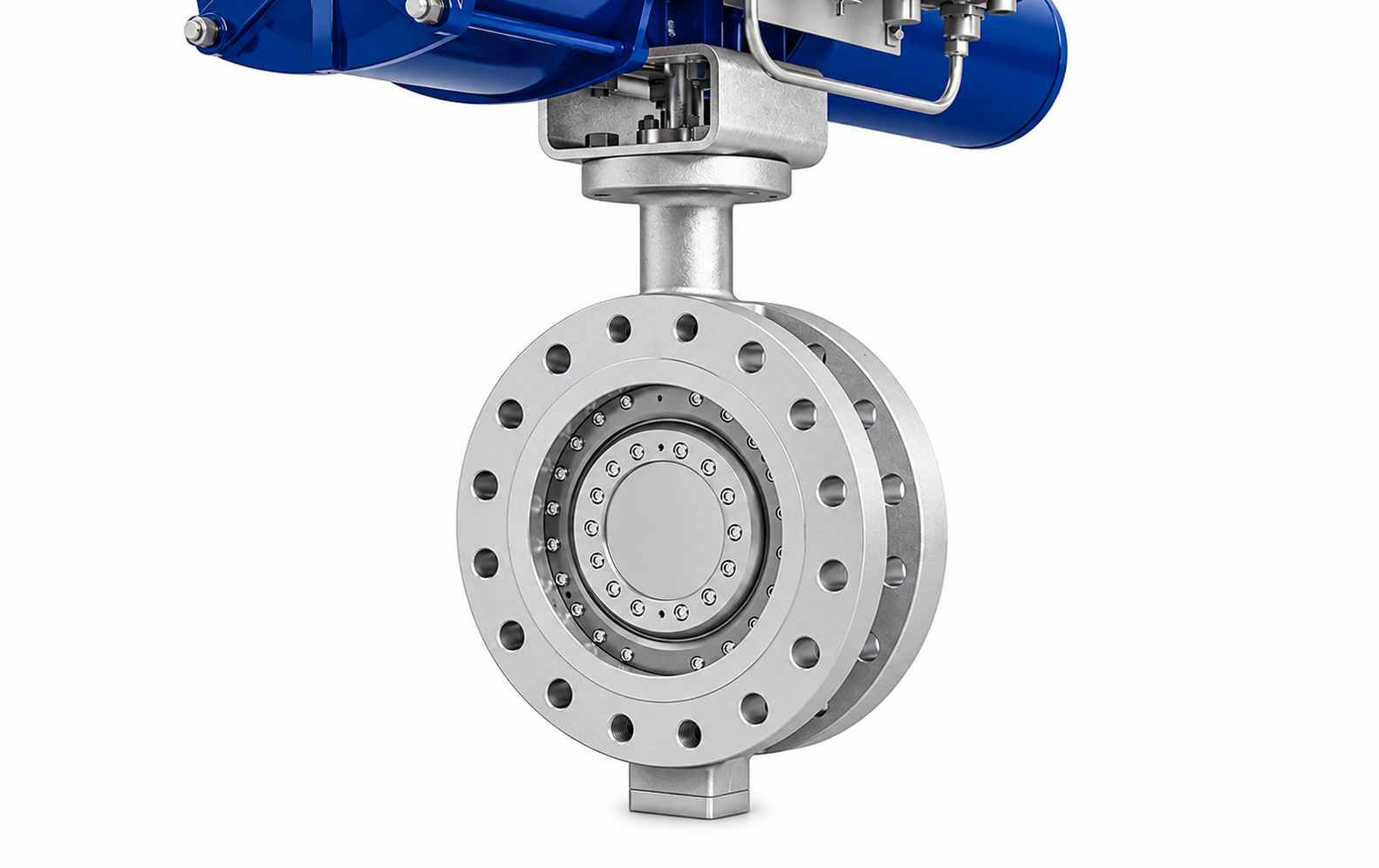
RPTFE seat seals with an O-ring energiser, made for tight shut-off in both flow directions on triple offset butterfly valves.
How it works
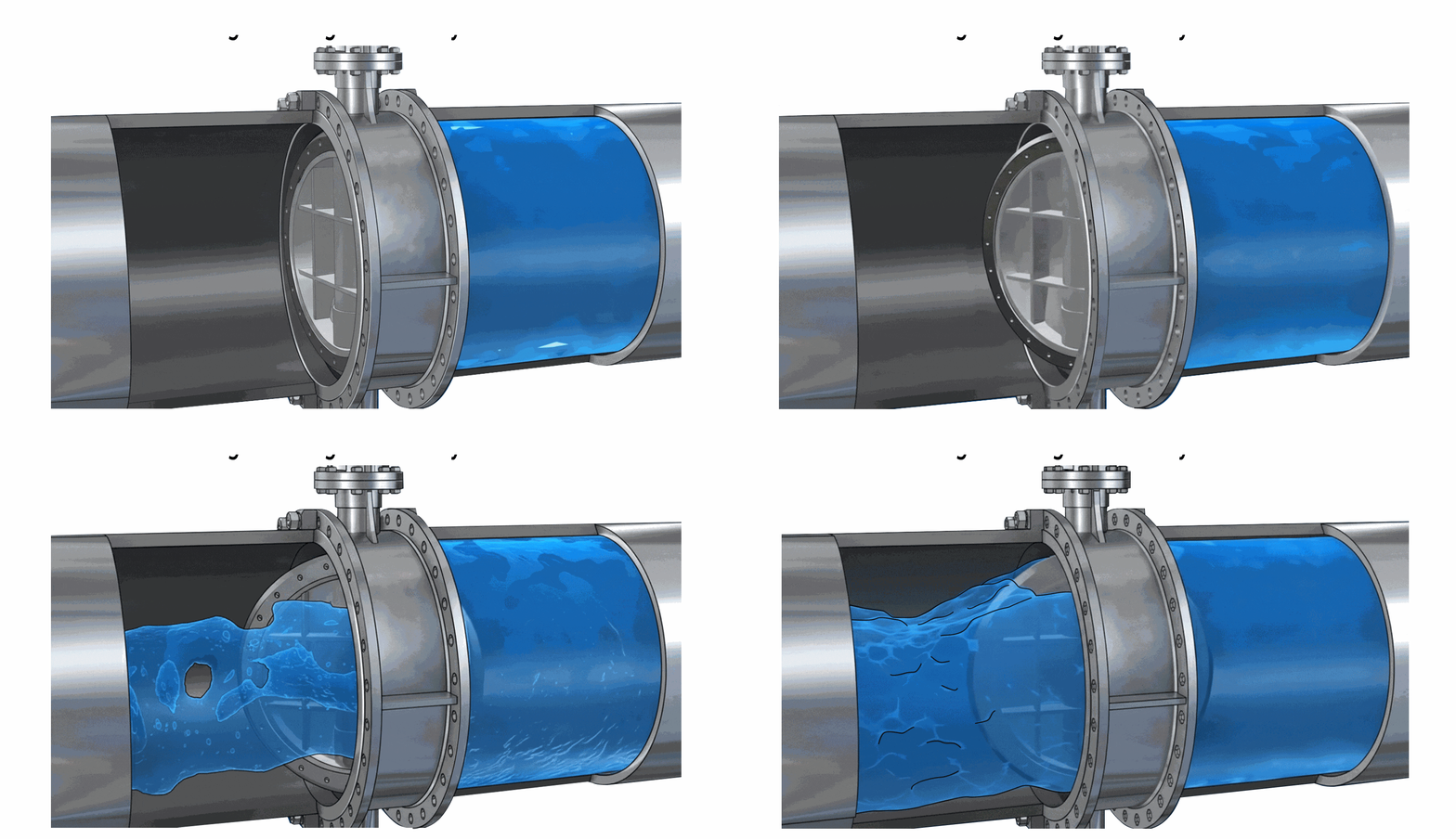
Everything in a triple offset valve is arranged so the seal never rubs on the seat. Each offset plays its part.

The shaft sits behind the sealing plane, so the seal runs all the way round the disc without a break.

The shaft is set to one side of the pipe centreline, so the disc swings away from the seat as it opens.

The seat is a cone tilted to the pipe centreline. This is the offset that stops the seal rubbing on the way in and out.
The seal touches the seat only at the very end of the stroke, with no sliding beforehand.
Good to know: there is no mechanical stop. The seat itself stops the disc, so the actuator's closing torque decides how hard the seal is pressed home.
Seal design
A machined RPTFE jacket does the sealing. An O-ring inside it works as a spring and keeps the jacket pressed against the seat.
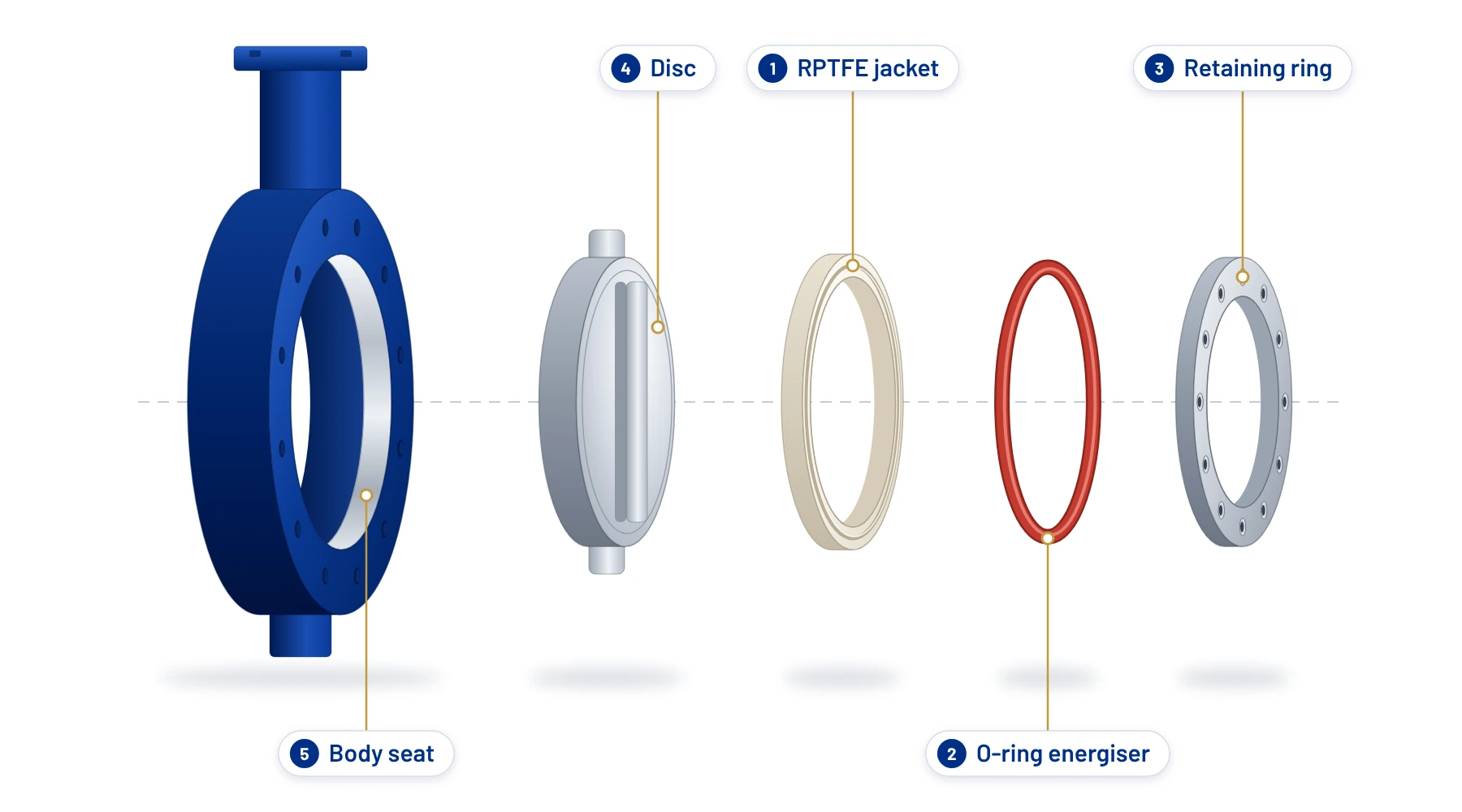
Glass or carbon filled PTFE. Its outer edge is the part that seals against the body seat.
Sits inside the jacket. See the O-ring options.
Part of the valve. It clamps the seal to the disc.
Carries the seal and turns with the shaft.
The conical seat machined into the valve body.
Some valve designs carry the seal in the body instead of on the disc. The seal is made to suit whichever arrangement the valve uses.
RPTFE slowly creeps under constant load and does not spring back like rubber. The O-ring takes up that relaxation, so the contact pressure on the seat holds.
The jacket, disc and body grow and shrink at different rates. The O-ring keeps the jacket in contact as the gaps open and close.
Small dimensional differences between the disc, retainer and seat are absorbed by the O-ring instead of leaving a gap.
The jacket sits between the line fluid and the rubber, so the O-ring is picked mainly for temperature and compression set.
When the open side of the jacket faces the pressure, line pressure adds to the O-ring's load. The higher the pressure, the tighter the seal.
The seal is a separate part, so it can be changed at overhaul without replacing the disc or the body seat.
Seal comparison
Most triple offset valves leave the factory with a laminated metal and graphite seal ring. An energised RPTFE seal is the better choice when the service temperature allows it.
| Feature | Energised RPTFE sealISMAT | Laminated seal ringMetal and graphite |
|---|---|---|
| Construction | Glass or carbon filled PTFE jacket with an elastomer O-ring energiser | Alternating layers of metal and flexible graphite |
| How it seals | The polymer face moulds itself to the seat, so it seals at low contact pressure | Metal-to-metal contact, so even loading and burr-free machining are critical |
| Upper temperature | +200 °C with silicone, +230 °C with FFKM | Well above any polymer, from cryogenic to high-temperature service |
| Fire safety | The valve needs a metal secondary seat to pass a fire test | All-metal, so fire-safe by design |
| Typical services | Water, chemicals, utilities and clean gases | Steam, hot hydrocarbons and fire-safe isolation |
Jacket grades
Four filled PTFE grades from the NOVUM range. The fillers make PTFE stiffer and harder wearing without losing its chemical resistance.
The usual starting point for water, utilities and mild chemicals.
For larger seals and higher seating loads.
The grade to use when the fluid attacks glass, such as strong alkalis or hydrofluoric acid.
For large rings that stay under load for long periods.
Energisers
Silicone is fitted as standard. The other three are there for the services silicone cannot handle.
Standard · Silicone
The widest temperature range of the four, and it stays flexible in the cold.
Option · FKM
For oils, fuels and other hydrocarbons that could reach the O-ring.
Option · EPDM
For hot water, steam exposure and outdoor valves that see weather and ozone.
Option · FFKM
For aggressive chemicals, and the highest upper temperature of the four.
The O-ring sets the limit. The jacket can take more heat than any of these O-rings, so the finished seal is only good for the O-ring's temperature range.
Technical data
Specification values from ISMAT technical data sheets.
| Property | NOVUM GF 0115% glass | NOVUM GF 0225% glass | NOVUM CF 0225% carbon | NOVUM GC 0110% glass + 15% carbon |
|---|---|---|---|---|
| Density ASTM D792, g/cc | 2.19 min. | 2.15–2.25 | 1.95–2.15 | 2.13–2.23 |
| Tensile strength ASTM D412, MPa min. | 15 | 10 | 10 | 10 |
| Elongation at break ASTM D412, % min. | 210 | 100 | 80 | 100 |
| Operating temperature °C | −200 to +260 | −200 to +260 | −200 to +250 | −200 to +260 |
| API 6A sour fluid immersion | Qualified | Qualified | Qualified | Qualified |
RPTFE jacket
O-ring energiser
Finished seal
Real limits also depend on seal design, pressure and the line fluid.
Selection guide
A starting point for the services these seals see most often.
| Service | Jacket | Energiser |
|---|---|---|
| Water, seawater and HVAC Ambient to moderate temperature | GF 01 or GF 02 | Silicone or EPDM |
| Hot water and steam exposure Up to +120 °C | GF 02, CF 02 or GC 01 | EPDM |
| Oils, fuels and hydrocarbons | GF 02 or GC 01 | FKM |
| Strong alkalis and hydrofluoric acid Media that attack glass | CF 02 | FFKM |
| Aggressive acids and solvents | GF 01 or GF 02 | FFKM |
| Cold outdoor service Down to −80 °C | GF 01 | Silicone |
Check media against the ISMAT Chemical Compatibility Guide and confirm by testing in your application.
Applications
Industries that use triple offset valves with RPTFE seat seals.
Intake, filtration, pumping and distribution valves, including seawater lines.
Chilled and hot water isolation in large buildings, plant rooms and district networks.
Process lines where the fluid attacks rubber or metal but leaves PTFE alone.
Cooling water, lube oil, fuel oil and utility systems on plants and terminals.
Condenser cooling water, condensate and auxiliary water circuits.
Ballast, bilge, engine cooling and seawater systems on ships and platforms.
Design guidance
Most seat leaks on triple offset valves trace back to geometry, clamping or seating torque rather than material. These points are worth checking early.
The third offset makes the seat a section of an inclined cone. The seal is elliptical and the angle of its face changes around the ring, so a seal turned to a simple taper will not seat evenly.
The retaining ring should hold the seal securely while letting it settle onto the seat. Overtightening distorts the jacket and squeezes the O-ring beyond its design compression.
A perfect sealing face is no use if fluid leaks round the back of the seal, between it and the disc. Keep the clamping faces flat and clean, and seal them with the jacket heel or a gasket.
A seating torque worked out for a laminated metal ring can overload an RPTFE face and make it creep faster. Check the actuator setting when changing to a soft seal.
Light machining marks do no harm, but a scratch running across the contact band is a leak path. Specify the body seat finish and protect it during assembly.
PTFE passes through a crystalline transition near 19 °C that changes its dimensions, which matters on large rings. Measure parts at a controlled 23 °C.
FAQ
Sometimes. It depends on whether the disc and retaining ring can hold an energised seal, whether the service temperature stays within the O-ring's range, and whether the valve has to remain fire-safe. Send the valve drawing and the operating conditions and we will check it.
Silicone, which works from −80 °C to +200 °C. FKM, EPDM or FFKM is fitted instead when the temperature or the line fluid calls for a different compound.
Fire safety belongs to the complete valve and is proven by fire type-testing to API 607 or ISO 10497. RPTFE and elastomers do not survive a fire, so soft-seated valves that pass these tests have a metal secondary seat that takes over once the soft seal has gone.
Triple offset valves are usually seat-tested to API 598, where a soft-seated valve must show no visible leakage in either direction. Some buyers specify ISO 5208 Rate A instead, or ANSI/FCI 70-2 Class VI for control valves. Tell us which one your valve is tested to.
ADVANCE with ISMAT
Send your valve details and our engineers will recommend a jacket grade, an energiser and the seal profile.
Disclaimer: The information on this page is general technical guidance and is not a service-life, pressure or temperature rating. Values are specification limits from ISMAT technical data sheets and do not by themselves indicate the performance of a finished part; evaluate parts under actual service conditions, particularly where failure may result in injury or damage.