
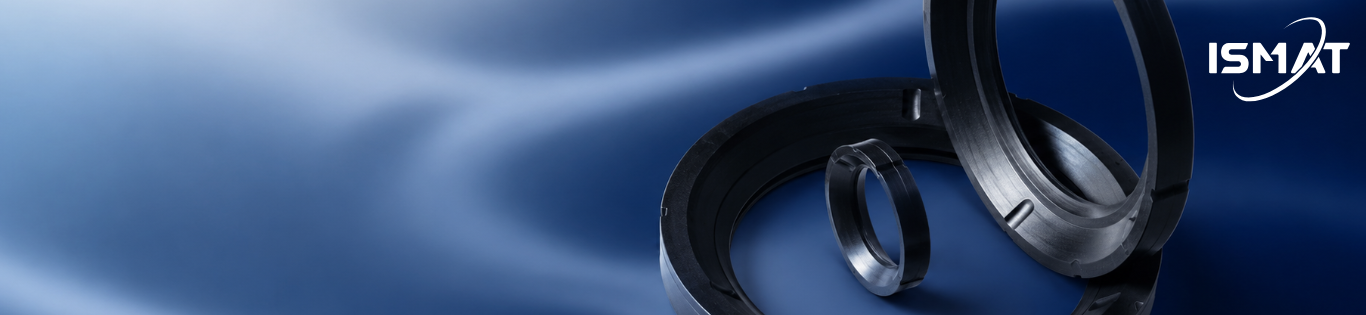
What is a Valve Seat?
A valve seat is the precision-machined ring inside a valve that the moving element (in a ball valve, the ball) presses against to form a tight seal. It sits on both sides of the ball and provides the contact surface that stops flow when the valve closes. Seats are made from polymers, metals or composite materials selected for compatibility with the fluid, temperature, pressure and wear conditions.
When the valve closes, line pressure forces the ball into the downstream seat, compressing the contact area to form a leak-free shutoff. Seat design and surface finish control load distribution and wear rate. Material choice affects chemical resistance, abrasion tolerance and deformation, while machining tolerances determine sealing accuracy and repeatability. Correct seat selection and precision manufacturing ensure reliable valve performance and long service life.
Novum Series at a Glance
ISMAT's engineering plastic valve seats are precision-machined in-house across our full range of high-performance thermoplastics. Our Novum series covers PTFE and PEEK grades as the core offering and we also machine valve seats from specialist materials including Vespel® CR-6100, Victrex CT 200, NEOFLON PCTFE M-300H, NEOFLON PCTFE M-400H, DEVLON V-API and TECASINT 1011 natural for applications that demand enhanced chemical resistance, superior dimensional stability or tighter mechanical performance. Every seat leaves our facility with full dimensional inspection and material traceability.
How Valve Seats Perform in a Floating Ball Valve
The floating ball mechanism is elegantly simple. Understanding exactly what happens at the seat during closure tells you why material precision matters so much.
Ball Floats Free
The ball is not mechanically anchored. Two seats hold it loosely in position, with the stem guiding rotation. Fluid flows freely through the open bore.
Quarter Turn Closes
A 90-degree rotation blocks the flow path. The ball swings across the bore and meets the downstream seat for the first time in that cycle.
Pressure Energizes the Seal
Line pressure from upstream pushes the ball firmly into the downstream seat. The engineering plastic deforms slightly, fills micro-gaps and creates the tight contact zone.
Seal Holds Under Load
The harder the fluid pushes, the tighter the seat holds. This self-energizing behavior is why precision-machined engineering plastic seats achieve ANSI Class VI performance consistently across thousands of cycles.
Why Engineering Plastics Are the Right Choice for Valve Seats
Specifying seat material is choosing the sealing mechanism itself. Engineering plastics deliver a set of properties that translate directly into operational advantages you can measure in service life, torque requirements and maintenance intervals.
Self-Lubricating by Nature
PTFE and PEEK-based materials carry an exceptionally low coefficient of friction. The ball glides against the seat rather than dragging, resulting in low operating torque, effortless actuation and wear rates far below most other seat materials.
Chemically Inert Across Media
Whether handling mild acids, solvents, water treatment chemicals, food-grade fluids or industrial process gases at normal conditions, Novum grades resist chemical attack without any external coating or lining.
Bubble-Tight Shutoff from Day One
The natural conformability of engineering plastics allows the seat to form intimate contact with the ball surface, yielding ANSI Class VI shutoff performance. This matters to anyone specifying valves for utility, instrumentation or process control lines.
Clean for Sensitive Processes
Virgin PTFE and PEEK grades are non-toxic, non-leaching and non-contaminating. Accepted in pharmaceutical, food and beverage and water treatment applications where seat material purity is a compliance requirement.
Predictable, Long Service Life
When matched to the right Novum grade for your specific media and temperature, you get consistent sealing performance across thousands of open-close cycles. The creep and wear properties are engineerable and quantifiable not variable.
Grade-Level Precision Matching
ISMAT's Novum range offers more than eight grades so you match your seat to your exact media compatibility and mechanical load, rather than accepting an approximation. This is the difference between a valve that performs and one that needs early replacement.
Novum Engineering Plastic Grades for Valve Seats
Each grade in the Novum series solves a specific combination of fluid compatibility, load resistance and wear demands. Selecting the right grade is the single most important decision in the specification process.
| Novum Grade | Material | Key Properties | Best Suited For |
|---|---|---|---|
| NOVUM VESP 01(CR6100) | Vespel® CR-6100 (DuPont Composite (Carbon Fibre Reinforced)) | API STD 610 / ISO 13709 CompliantOperating Range -46°C to 230°CExtremely Low Creep Under LoadHigh Compressive Strength 174 MPaHostile Chemical Environment ResistanceNear-Zero Water Absorption 0.01% | Severe-service valve seats in petroleum, petrochemical and natural gas service per API STD 610 / ISO 13709. Applications where PTFE cold flow under sustained differential pressure is a known failure mode and dimensional stability under load is non-negotiable. |
| NOVUM PKCT 01 | Victrex CT 200 (PAEK Thermoplastic (Cryogenic Grade)) | Cryogenic Service to -196°CTensile Strength 140 MPa at -196°CCompressive Stress 250 MPa at -196°C25% Elongation at 23°CMelting Point 343°C | Cryogenic valve seats for LNG, liquid nitrogen, liquid oxygen and ultra-low temperature process valve assemblies operating down to -196°C. Ideal where standard PEEK or PTFE grades lose ductility or dimensional integrity at extreme low temperatures and where high mechanical strength retention combined with room-temperature flexibility is required in dynamic sealing service. |
| NOVUM PCT 01 | NEOFLON PCTFE M-300H (PCTFE Fluororesin (Daikin)) | Highest Gas Barrier of All FluororesinsNear-Zero Gas PermeationShore D Hardness 80High Elongation 189%Melting Point 212°CFull Fluoropolymer Chemical Resistance | Valve seats in gas isolation, instrument valve and gas metering applications where permeation through the seat body is a critical failure concern. Standard PTFE allows measurable gas transmission through its structure. PCTFE's near-zero permeation eliminates that risk. Also suitable where higher hardness and better cold flow resistance than virgin PTFE is needed while retaining full fluoropolymer chemical resistance. |
| NOVUM PCT 01 | NEOFLON PCTFE M-400H (PCTFE Fluororesin High Molecular Weight (Daikin)) | Higher Molecular Weight than M-300HSuperior Stress Crack ResistanceNear-Zero Gas PermeationShore D Hardness 80Tensile Strength 47.6 MPaCompression Moulding Optimised | Thick-section and large bore valve seats where compression moulding of heavy cross-sections is required without cracking or void formation during processing. M-400H's higher molecular weight and superior stress crack resistance make it the preferred PCTFE grade over M-300H for sustained load valve seat applications and larger valve sizes where seat wall thickness is significant. Gas isolation valve seats requiring near-zero permeation with long-term dimensional integrity under continuous differential pressure. |
| NOVUM PA01 | DEVLON V-API (Polyamide Composite — API Valve Grade (James Walker Devol)) | API Valve Service RatedCompressive Strength 140 MPaShore D Hardness 82/85Long Term Service to 125°CLow Specific Gravity 1.14 | API-rated floating ball valve seats in oil and gas service where high compressive strength, elevated heat distortion resistance and low specific gravity are required simultaneously. Hydrocarbon pipeline and wellhead valve seats in dry or low-water-contact service. A direct specification match for valve OEMs building to API 6D, API 608 or API 6A standards. Note: water absorption at saturation reaches 3%, so aqueous service applications require careful evaluation before specifying this grade. |
| Novum P 01 | Virgin PTFE | Ultra-low frictionFull chemical inertnessFDA-compliantExcellent conformability | Water, mild acids, alkalis, general process fluids. Food and pharmaceutical applications. |
| Novum M 03 | Modified PTFE (TFM) | Better creep resistance vs virginImproved weld-seam integrityLower deformation under load | Utility valves and low-to-medium cycle applications where dimensional stability over time matters. |
| Novum GF 01 | 15 Pct Glass Filled PTFE | Enhanced wear resistanceImproved compressive strengthRetains PTFE chemical resistance | Higher cycle-count applications and valves handling mild abrasive carry-over in the fluid stream. |
| Novum GF 02 | 25 Pct Glass Filled PTFE | Higher stiffness than GF01Superior dimensional stabilityReduced cold flow under sustained load | Industrial process lines with sustained differential pressure across the seated valve. |
| Novum MOF 01 | Glass and MoS2 Filled PTFE | Excellent wear resistanceSelf-lubricating under dry conditionsDimensional stability under load | Dry-running risk conditions and high cycle frequency industrial valve service. |
| Novum CF 02 | Carbon Filled PTFE | High compressive strengthStatic dissipativeLow permeationAPI 6A suitable | Chemical and solvent lines where electrical neutrality of the seat material is specified. |
| Novum PK 01 | Virgin PEEK | Outstanding mechanical strengthExcellent chemical resistanceVery low creepDimensional precision | Applications demanding tighter dimensional tolerances or higher mechanical load resistance in demanding industrial service. |
| Novum PKC Series | PEEK Composite | Tailored strength and wearStable under loadHigh precision machining | High-performance OEM applications and custom seat geometries requiring tight batch-to-batch repeatability. |
All Novum grades are precision-machined in-house at ISMAT. Custom seat profiles, non-standard bore sizes and special face geometries are available on request. If you have a drawing or a worn seat to reverse-engineer, we can work from either.
Need to Match the Right Seat Material to Your Application?
Specification decisions are faster when you talk to someone who has been solving them for over 40 years. Share your media, cycle frequency and size range with our application engineers and get a direct recommendation with no back-and-forth.
Industries We Serve
Where ISMAT Engineering Plastic Valve Seats Are Specified
Engineering plastic seats serve wherever a floating ball valve needs clean, reliable shutoff under normal service conditions. These are the industries where Novum grades have become the preferred seat material.

Oil & Gas
Carbon filled and glass filled PTFE valve seats for pipeline isolation valves, wellhead ball valves and hydrocarbon transfer lines
→
Chemical Processing
Chemically inert PTFE and PEEK valve seats for ball valves handling acids, solvents, alkalis and aggressive process fluids in reactor and piping systems
→
Aerospace
High-precision PEEK and virgin PTFE valve seats for fluid control valves in hydraulic systems, fuel management lines and ground support equipment
→
Energy
Dimensionally stable PTFE valve seats for ball valves in cooling water circuits, chemical dosing lines and fluid isolation systems in power generation plants
→
Automotive
Modified PTFE and glass filled valve seats for ball valves in engine coolant circuits, fluid transfer assemblies and EV battery thermal management systems
→
Food & Beverage
FDA 21 CFR and EC 1935/2004 compliant virgin PTFE valve seats for ball valves in food processing lines, CIP systems and beverage filling equipment
→
Mining
Wear-resistant glass and MoS2 filled PTFE valve seats for ball valves controlling water, chemical reagents and mild slurry flows in mineral processing plants
→
Agriculture
Chemical-resistant virgin PTFE valve seats for ball valves used in fertiliser dosing, pesticide distribution and irrigation flow control systems
→Advantages of ISMAT Engineering Plastic Valve Seats
Performance of a valve seat comes down to three things: how well it seals when closed, how long it holds that seal across repeated cycles and how little trouble it causes over its service life.
Precision-Machined for True Ball Contact
Every seat leaves ISMAT's facility machined to dimensional tolerances that ensure full, even contact with the valve ball. Inconsistent geometry is one of the most common causes of early seat leakage and tolerances held under CNC control eliminate that variable from the start.
No External Lubrication Required
The natural low-friction surface of PTFE and PEEK-based materials means the ball rotates against the seat without dragging. This delivers lower operating torque and eliminates the contamination risk that comes with lubricant application in sensitive fluid environments.
Consistent Sealing Across Thousands of Cycles
Properly specified engineering plastic grades maintain their sealing geometry through high cycle counts. The conformability that creates the initial seal stays consistent with use, meaning your valve continues to hold shutoff long into its service life without re-seating.
Grade Selection for Your Specific Duty
ISMAT's range of Novum grades means you are specifying a seat that matches your exact media compatibility and mechanical load, not accepting a compromise. This grade-specific approach is what separates a valve that performs reliably from one that needs premature attention.
Custom Profiles and Bore Sizes Available
Standard seat profiles fit standard applications. But valve design rarely stays entirely standard. ISMAT machines custom seat geometries, non-catalogue bore sizes and special face angles to match OEM valve body drawings, with full CNC repeatability across production batches.
Full Traceability and Certification
Every ISMAT product shipment is traceable to the raw material batch and manufacturing date through our ISO 9001:2015 quality management system. Material certificates, dimensional inspection reports and conformity documentation are available on request to support your incoming quality checks.
Why Valve OEMs and Plant Engineers Choose ISMAT for Valve Seats
There is a reason companies like Flowserve, Bray and Grundfos have worked with ISMAT for years. It is not just the materials. It is what ISMAT does with them.
Over 40 years of engineering thermoplastics expertise means our team can look at an application, a media specification or a worn-out seat and tell you exactly which Novum grade fits, why it fits and what to expect from it in service. That institutional knowledge does not exist at a catalogue-order supplier. It comes from decades of solving real application problems for real industrial customers.
Our in-house CNC machining capability means you are dealing with a single source for both material expertise and the finished component. There is no gap between specification and production. When we say a seat is machined to tolerance, we can show you the inspection data.
And because ISMAT holds safety stock in both raw engineering plastic compounds and finished standard profiles, lead times for standard sizes are short. For custom work, our in-house tooling capability means prototyping and first-article inspection move fast.
Trusted by Industry Leaders
 Flowserve
 Caterpillar
 Bray
Bray
 ONGC
ONGC
 ISRO
ISRO
 Vedanta
 NPCIL
NPCIL
 Voith
Voith
Get In Touch
Contact ISMAT for Engineering Plastic Valve Seats
Whether you need standard PTFE seats in quantity, a custom geometry machined to your drawing or technical guidance on which Novum grade fits your application, this is the right conversation to start.
Send us your seat dimensions, valve body drawing or fluid specification. Our application engineering team responds within one working day with a recommendation and where required, a quotation.