
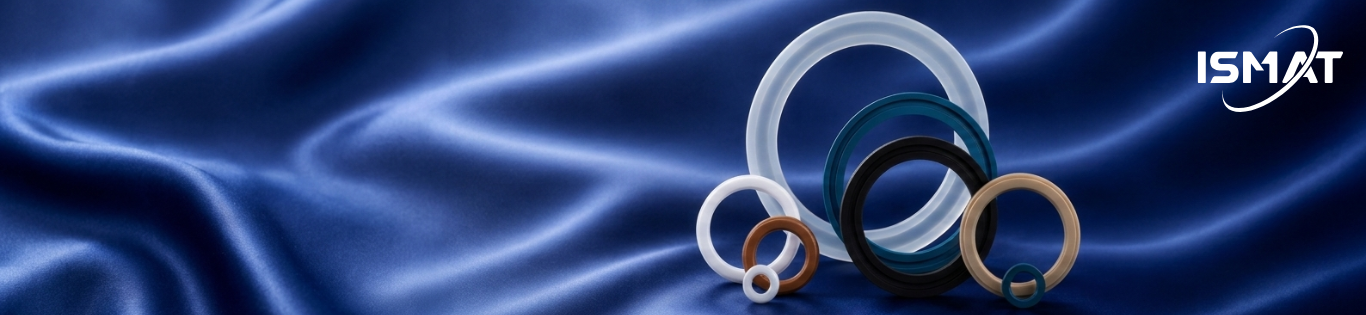
What Sets Them Apart
BUILT TO HOLD PRESSURE WHEN OTHER SEATS GIVE WAY
Standard valve seats do the job well enough in normal conditions. But when the pressure goes up, the temperature drops to cryogenic levels or harsh chemicals start attacking the sealing surface, things change quickly. The seat material begins to deform, creeps out of its groove and the valve develops an internal leak. That is exactly when you need a high-performance valve seat.
High performance valve seats are machined from advanced engineering polymers like Vespel® CR-6100, Victrex CT 200, NEOFLON PCTFE, DEVLON V-API, TECASINT 1011 and ISMAT Novum grades (PTFE, PCTFE and PEEK). These materials hold their shape under extreme pressure, seal reliably across cryogenic to high-temperature ranges and stand up to sour gas, strong acids and abrasive media without breaking down. They are built for floating and trunnion ball valves used in oil and gas, LNG, chemical processing and power generation where seat failure simply is not acceptable.
MATERIAL PROFILE
NOVUM VESP 01 (CR-6100) / Vespel® CR-6100
DuPont Composite (Carbon Fibre Reinforced)
NOVUM VESP 01 (CR-6100) / Vespel® CR-6100 Valve Seats
Vespel® CR-6100 is a carbon fibre reinforced PFA composite developed by DuPont. It was originally designed for stationary wear components in centrifugal pumps but has become one of the most trusted materials for high-performance valve seats in the oil and gas, refining and chemical processing industries. The reason is simple. It does not cold-flow. Even under sustained compressive load and high differential pressure, the seat holds its shape and stays in the retainer groove where it belongs.
What makes CR-6100 different from standard PTFE or nylon seats is its combination of near-universal chemical resistance with a compressive modulus of 8,520 MPa. That means it can handle virtually any process fluid while resisting the kind of deformation that causes internal leakage in conventional seat materials. It also has a coefficient of thermal expansion lower than steel in the x-y plane, which means tight running clearances are maintained even as the valve cycles through wide temperature swings from cryogenic conditions all the way up to 288°C.
ISMAT machines Vespel® CR-6100 valve seats under the Novum VESP 01 designation. Every seat is CNC-machined to customer drawings with full dimensional inspection and lot traceability. Whether you are building floating ball valves, trunnion-mounted valves or centrifugal pump wear components, this material gives you a seat that performs reliably in the harshest environments without the ongoing maintenance headaches that come with softer seating materials.
NOVUM PKCT 01 / Victrex CT 200 VALVE SEATS
NOVUM PKCT 01 is ISMAT's cryogenic-grade PAEK polymer, engineered specifically for dynamic sealing and valve seat applications at very low temperatures. It is the material you choose when a standard soft seat cannot maintain its geometry through repeated thermal cycling, when gas permeation is a disqualifying risk or when the valve must remain fully functional from ambient temperature all the way down to liquid nitrogen service.
The polymer belongs to the PAEK (polyaryletherketone) family — the same family of materials behind decades of proven PEEK performance in oil and gas, but developed specifically for the cryogenic end of the operating range. Where conventional thermoplastics become brittle and lose elongation in the cold, NOVUM PKCT 01 retains ductility and dimensional control. At -196°C, the tensile yield stress rises to 140 MPa and the flexural modulus reaches 5,000 MPa — the material does not soften or creep under sustained ball contact load. It stiffens predictably and it holds.
ISMAT machines NOVUM PKCT 01 to finished seat dimensions using in-house tooling, with part-level acceptance criteria held to a minimum tensile of 66 MPa and minimum elongation of 5% — conservative values that reflect real machined-part performance not raw material optimums.
MATERIAL PROFILE
NOVUM PKCT 01 VALVE SEATS PAEK
Polyaryletherketone (Cryogenic Grade)
ISMAT MATERIAL SERIES
Novum PKCT — Cryogenic PAEK
| Key Features |
|---|
|
MATERIAL PROFILE
NOVUM PCT 01 PCTFE
Polychlorotrifluoroethylene (Daikin NEOFLON M-300H / M-400H)
NOVUM PCT 01 / NEOFLON PCTFE VALVE SEATS
NOVUM PCT 01 is ISMAT's PCTFE-based valve seat grade, compounded from Daikin's NEOFLON polychlorotrifluoroethylene the fluororesin with the highest gas barrier property in its class. It was built for one specific problem: applications where gas permeation through the seat material is simply not an option. Liquid oxygen systems, liquid nitrogen isolation valves, LNG service, cryogenic air separation anywhere the process medium must not cross the seat boundary, PCTFE is the material valve engineers have trusted for decades and NOVUM PCT 01 is ISMAT's machined, part-qualified implementation of that material.
ISMAT machines NOVUM PCT 01 valve seats to customer drawings under in-house dimensional inspection and lot traceability. Part-level minimum acceptance criteria are held to 35 MPa tensile strength and 50% elongation at break conservative values that account for the machining process and reflect real finished-part performance. Whether you are specifying seats for cryogenic ball valves, liquid oxygen service components or chemical processing isolation valves, NOVUM PCT 01 gives you a dimensionally stable, chemically resistant seat that holds its seal at temperatures where almost every other soft seat material has already failed.
NOVUM PA01 / DEVLON V-API VALVE SEATS
NOVUM PA 01 is ISMAT's polyamide valve seat grade, machined from DEVLON V-API — the James Walker Devol compound formulated specifically for API-rated ball valve seat service. Not a general-purpose plastic adapted for valves, but a material built from the ground up for floating and trunnion-mounted ball valves in oilfield service. That purpose-built pedigree is why DEVLON V-API is specified by name across North Sea, Middle East and offshore valve programmes.
Its standout mechanical characteristic is cold-condition behaviour — tensile strength increases from 79.92 MPa at ambient to 109.52 MPa at -40°C. The seat gets tougher as service conditions get harder. Compressive strength reaches 140 MPa and deformation under sustained 140 kgf/cm² load over 24 hours stays within 1.0–2.0%. That resistance to creep under load is what keeps the seat sealing reliably between cycles.
ISMAT machines NOVUM PA 01 to finished dimensions with full dimensional inspection and lot traceability. Long-term service temperature is 125°C, short-term 190°C. Note that moisture absorption reaches 3% at saturation, making this grade unsuitable for prolonged steam or hot aqueous service. For hydrocarbon, crude oil, produced water and natural gas applications, it consistently outlasts standard PTFE seats in abrasive or dynamic duty.
MATERIAL PROFILE
NOVUM PA 01 Polyamide Composite
API Valve Grade (James Walker Devol — DEVLON V-API)
ISMAT MATERIAL SERIES
Novum PA 01 — API Polyamide
| Key Features |
|---|
|
MATERIAL PROFILE
TECASINT 1011 PI
Pure Polyimide (Ensinger — Unfilled Natural Grade)
TECASINT 1011 VALVE SEATS
TECASINT 1011 is a pure, unfilled polyimide — the hardest and highest-temperature thermoplastic in ISMAT's valve seat material portfolio. Shore D hardness of 90, compressive strength of 450 MPa, heat distortion temperature of 368°C and a glass transition point of 383°C. These are not marginal improvements on conventional seat materials; they are a different category entirely. When a valve must seal reliably under extreme compressive load at temperatures that would deform or destroy every PTFE, PEEK or fluoropolymer seat on the market, TECASINT 1011 is the correct specification. High-temperature steam isolation, thermal power plant block valves, reactor service and precision engineering applications where dimensional creep is simply not tolerable — this is where it belongs.
ISMAT machines TECASINT 1011 to finished seat dimensions from Ensinger certified stock shapes, with full dimensional inspection and lot traceability. The material carries UL 94 V0 flammability rating and passes ECSS-Q-70-02 outgassing qualification for aerospace and vacuum service. One limitation that must be carried into every specification: TECASINT 1011 absorbs 1.3% moisture at 24 hours and 3.8% at 80°C and the full 1000 series is sensitive to hydrolysis at higher temperatures — parts require pre-drying before any rapid heating above 200°C. Steam service and sustained hot aqueous exposure are outside its correct application window. Within the right conditions, nothing else on this page matches its thermal and mechanical ceiling.
ISMAT NOVUM GRADE VALVE SEATS
The ISMAT Novum series covers the full range of engineering thermoplastic valve seat materials from virgin PTFE through filled and composite grades to high-performance PEEK and cryogenic PCTFE. Every grade is compounded, machined and quality-inspected in-house at ISMAT's facility. Whatever the service — hydrocarbon, sour gas, high-cycle trunnion ball valve or cryogenic LNG — the correct Novum grade exists and ISMAT manufactures it.
The PTFE family spans nine grades, each answering a specific valve seat failure mode. Novum P 01 delivers maximum chemical inertness from -200°C to +260°C. Novum M 03 is API 6A certified for sour service. Novum CF 02 and GF 02 carry API 6A certification for high-load and abrasive duty. Novum BF 01 adds compressive hardness; Novum CN 05 handles extreme pressure with low fatigue deformation. These are not generic upgrades — each grade targets a specific problem.
The PEEK family — Novum PK 01 and PKC composites — takes valve seat performance where PTFE cannot go: continuous service to 260°C, Class 1500 and beyond, and wear resistance in high-cycle dynamic applications. Novum PCT 01 closes the cryogenic end with Shore D 80 hardness, near-zero moisture absorption and reliable service from -200°C through LNG, liquid oxygen and liquid nitrogen service.
MATERIAL PROFILE
Novum
PTFE · PEEK · PCTFE
| Key Features |
|---|
|
Need to Match the Right Seat Material to Your Application?
Specification decisions are faster when you talk to someone who has been solving them for over 40 years. Share your media, cycle frequency and size range with our application engineers and get a direct recommendation with no back-and-forth.
Industries We Serve
Where ISMAT Engineering Plastic Valve Seats Are Specified
Engineering plastic seats serve wherever a floating ball valve needs clean, reliable shutoff under normal service conditions. These are the industries where Novum grades have become the preferred seat material.

Oil & Gas
Carbon filled and glass filled PTFE valve seats for pipeline isolation valves, wellhead ball valves and hydrocarbon transfer lines
→
Chemical Processing
Chemically inert PTFE and PEEK valve seats for ball valves handling acids, solvents, alkalis and aggressive process fluids in reactor and piping systems
→
Aerospace
High-precision PEEK and virgin PTFE valve seats for fluid control valves in hydraulic systems, fuel management lines and ground support equipment
→
Energy
Dimensionally stable PTFE valve seats for ball valves in cooling water circuits, chemical dosing lines and fluid isolation systems in power generation plants
→
Automotive
Modified PTFE and glass filled valve seats for ball valves in engine coolant circuits, fluid transfer assemblies and EV battery thermal management systems
→
Food & Beverage
FDA 21 CFR and EC 1935/2004 compliant virgin PTFE valve seats for ball valves in food processing lines, CIP systems and beverage filling equipment
→
Mining
Wear-resistant glass and MoS2 filled PTFE valve seats for ball valves controlling water, chemical reagents and mild slurry flows in mineral processing plants
→
Agriculture
Chemical-resistant virgin PTFE valve seats for ball valves used in fertiliser dosing, pesticide distribution and irrigation flow control systems
→