
Seal failures in industrial systems rarely happen without warning signs. One of the most overlooked warning signs is the gradual loss of sealing force. This loss occurs not because the seal has moved, cracked or been exposed to an incompatible fluid, but simply because the material has lost its ability to push back against the mating surfaces over time. This phenomenon is called compression stress relaxation and it is one of the primary reasons seals that are correctly installed and dimensioned still fail before the end of their intended service life.
This blog explains what compression Stress relaxation is, how it occurs, how it is measured and what engineers and procurement professionals should consider when specifying seals for long-term industrial applications.
Understanding Compression Stress Relaxation
When a rubber or elastomer seal is compressed between two rigid surfaces (a valve seat, a flange face, a pump housing), it pushes back against those surfaces with a measurable force. This reactive force is what maintains the pressure barrier and prevents leakage. The seal functions if this force remains above the minimum threshold required for the application.
The important thing to understand is that the gap between the mating surfaces stays fixed. The seal is not given the opportunity to relax its shape. Despite this, the force it exerts decreases Over time. This is compression stress relaxation: the reduction in stress and therefore sealing force, in a material held at constant strain.
Since the deformation of the seal does not change, the sealing force at any point in time is governed by the elastic modulus of the material. As the modulus decreases, so does the sealing force. Compression stress relaxation is therefore a direct, continuous measure of how the modulus of sealing material changes under real service conditions over time.
A seal that generates 500 N of sealing force at installation but drops to 180 N after one year of operation may have appeared perfectly functional at commissioning. If the minimum required sealing force for that application is 200 N, it has already failed, even though it was never removed, never inspected and never flagged by a pressure drop alarm.
How Compression Stress Relaxation Differs from Compression Set
Compression set and compression stress relaxation are related but measure fundamentally different things. Confusing the two leads to incorrect material comparisons and unreliable service life predictions.
| Property | Compression Set | Compression Stress Relaxation |
|---|---|---|
| When measured | After load is removed | While under continuous compression |
| What is tracked | Permanent dimensional change | Decay of internal stress (sealing force) |
| Deformation state | Specimen is freed and allowed to recover | Deformation is fixed throughout test |
| Relevance | End-of-life condition | Ongoing performance throughout service life |
| Operational use | Indicates shape recovery | Predicts residual sealing force at any point |
A material can score well on a compression set test and still relax at a rate that reduces sealing force to an unsafe level well within the maintenance interval. Compression set gives useful end-of-life information. Compression stress relaxation gives information about what is happening throughout the service period, which is when it matters most.
For any application where the seal is expected to hold without inspection for months or years, compression stress relaxation data is more operationally relevant than compression set alone.
The Mechanisms That Cause Relaxation
The decay in sealing force occurs through two mechanisms. Both are driven by the molecular structure of the polymer and both are influenced by temperature and time.
Physical relaxation occurs because polymers are not perfectly elastic. Under sustained compressive load, the chain segments within the polymer network gradually rearrange into lower-energy configurations. As they do, the stored elastic energy that generates sealing force is progressively dissipated. This process does not permanently damage the polymer network. It is an expression of the visco-elastic nature of rubber. Physical relaxation tends to be more prominent in the early stages of compression and slows as the molecular rearrangement reaches a new equilibrium.
Chemical relaxation is more serious because the changes are permanent. At elevated temperatures, two processes degrade the cross-linked polymer network. The first is chain scission, where molecular bonds along the polymer backbone break, shortening the chains and reducing their ability to generate elastic restoring force. The second is continued cross-linking, where new bonds form in the compressed configuration, locking the network in the deformed state. Both processes reduce the material’s capacity to push back and neither is reversible.
Chemical relaxation becomes the dominant mechanism at elevated temperatures (typically above 100 degrees C for standard elastomers) and over longer time periods. At moderate temperatures, physical relaxation contributes more to the early-stage decay, while chemical degradation governs long-term behaviour.
| Mechanism | Nature | Dominant Conditions | Reversible? |
|---|---|---|---|
| Physical relaxation | Polymer chain rearrangement into lower-energy states | Early-stage, moderate temperatures | Yes |
| Chemical relaxation | Chain scission and continued cross-linking | Elevated temperatures, long durations | No |
This distinction has a direct consequence for how test data should be interpreted. Running an accelerated high-temperature test to predict long-term low-temperature performance is not straightforward. The ratio of physical to chemical relaxation changes significantly with temperature. A short test at 200 degrees C does not faithfully replicate what happens at 80 degrees C over three years, because the degradation of chemistry is different. Extended testing at or near the actual operating temperature gives more reliable service life data than extrapolating from high-temperature acceleration alone.
How Compression Stress Relaxation Is Measured
The measurement method is defined by ISO 3384, which covers compression stress relaxation of vulcanised rubber at normal and elevated temperatures. The test uses small cylindrical rubber button specimens (the preferred size being 13 mm in diameter and 6.3 mm thick) compressed to a defined strain between rigid plates with a surface finish of 0.2 micrometers or better. The standard preferred compression level is 25 plus or minus 2% of the original specimen’s height.
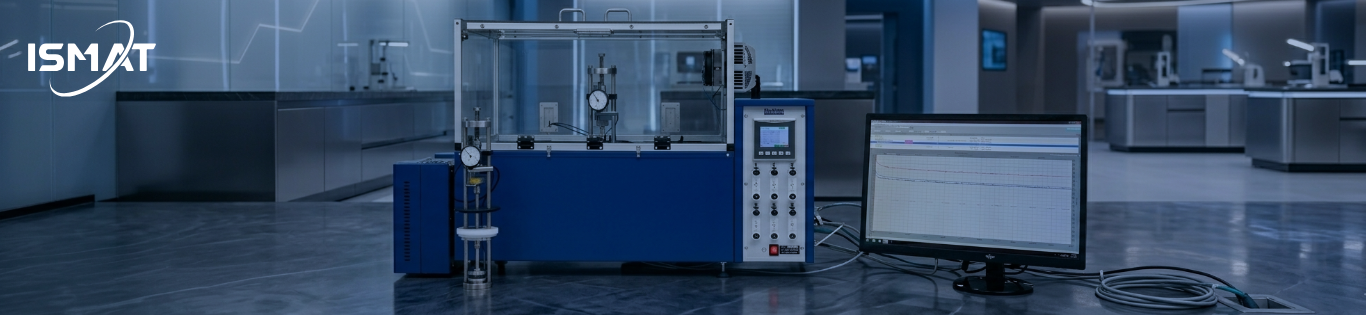
Because tests typically run for days, weeks or months and because multiple specimens are usually being monitored simultaneously, the standard approach uses separate compression jigs (one per specimen) and a single shared force measuring head that cycles through each jig in sequence.
To measure force without disturbing the state of compression, the force measuring head applies a tightly controlled micro-displacement to the top plate of the jig, limited to 0.05 mm under ISO 3384, sufficient to break an electrical contact within the jig. The moment the contact opens, the applied force equals the specimen’s compressive reaction force. The reading is captured and the head immediately withdraws. The entire measurement must be completed within 30 seconds.
ISO 3384 specifies two test procedures to cover different service scenarios. The American standard ASTM D6147-97(2020), titled Standard Test Method for Vulcanized Rubber and Thermoplastic Elastomer: Determination of Force decay (Stress Relaxation) in Compression, provides two parallel methods and is the primary ASTM reference for this type of testing. It was developed based on testing in both air and liquids, making it applicable to both dry and immersion service conditions. ASTM D6147 is the current and applicable American standard for this measurement; references to the older ASTM D1390 should be treated as superseded.
| Procedure | Measurement Condition | Best Suited For | Standard Equivalent |
|---|---|---|---|
| Procedure A | Specimen compressed and all force measurements taken at test temperature throughout | Continuous high temperature service; captures physical and chemical relaxation simultaneously under thermal load | ISO 3384 |
| Procedure B | Specimens stored at test temperature between measurements; cooled to ambient before each force reading | Where measurement at elevated temperature is not practical; common in quality control testing | ISO 3384 |
| ASTM D6147 Method A | Specimen compressed and measured entirely at test temperature; deformation completed within 30 seconds | Seals and gaskets in continuous elevated temperature service; American standard covering vulcanized rubber and thermoplastic elastomers | ASTM D6147- 97(2020) |
| ASTM D6147 Method B | Specimen aged at test temperature; returned to ambient for each force measurement; covers testing in both air and liquid media | Applications where in-situ high-temperature force measurement is impractical; suitable for immersion service evaluation | ASTM D6147- 97(2020) |
| BS 903 Part A34 | Ring specimens with drilled compression plates; measured under immersed conditions | Liquid immersion and fluid contact applications; three defined procedures including measurement under fluid | British Standard |
Reading and Using Relaxation Data
A CSR test produces a curve showing the residual force (typically expressed as a percentage of the initial force) plotted against time on a logarithmic scale.
Most elastomers show a relatively rapid drop in the first few hours of compression, followed by a progressively slower rate of decline. For well-formulated materials at appropriate service temperatures, the curve approaches a near-plateau. Materials that show continued steep decline after the initial period or a secondary acceleration in relaxation rate at longer times, are exhibiting signs of chemical network degradation. This is a signal that the material is being used at or beyond its thermal stability limit for that duration.
The practical question for any application is: what percentage of the initial sealing force remains at the end of the maintenance interval and is that residual force sufficient?
| Residual Force at 1,000 Hours | Interpretation | Recommended Action |
|---|---|---|
| Above 70% | Strong retention; material well within thermal limit | Confirm against minimum sealing force requirement |
| 50% to 70% | Acceptable for many applications; monitor trend | Validate against application minimum threshold |
| 30% to 50% | Moderate degradation; risk at longer intervals | Review maintenance schedule and groove design |
| Below 30% | Significant degradation; high failure risk | Evaluate alternative elastomer compound |
Requesting relaxation data at the actual operating temperature and for a test duration that approximates the maintenance interval gives the most reliable basis for this comparison. Single point compression set values taken at a standard temperature cannot substitute for this.
Material Selection for Compression Stress Relaxation Resistance
The choice of elastomer family has the greatest influence on long-term relaxation behaviors. Compound formulation within a family (particularly the cross-link density and cure system) also plays a significant role.
| Elastomer | Key Property | ISMAT Series | Relative Relaxation Resistance |
|---|---|---|---|
| FFKM (Perfluoroelastomer) | Highest resistance to chemical relaxation; fully fluorinated backbone | Vertex F | Excellent |
| FKM (Fluorocarbon Rubber) | Stable C-F backbone; resists oxidative chain scission | Vertex FC | Very Good |
| FEPM (AFLAS) | Good thermal stability in aggressive chemical environments | Vertex A | Good |
| HNBR (Hydrogenated Nitrile) | Saturated backbone; better thermal oxidation resistance than NBR | Vertex H | Good |
| EPDM | Saturated main chain; reliable in steam and hot water | Cerulean EP | Moderate |
| NBR (Nitrile Rubber) | General industrial use; higher relaxation above 80 degrees C | Cerulean N | Moderate to Low at elevated temperature |
Specific compound formulation and post-cure treatment can shift performance within each family.
Factors That Influence Relaxation Rate in Service
Several operating conditions directly affect how quickly a seal loses sealing force in practice. All of them should be considered during the specification process.
| Factor | Effect on Relaxation | Design Consideration |
|---|---|---|
| Temperature | Accelerates both physical rearrangement and chemical degradation | Specify with thermal margin above rated continuous limit |
| Duration | Relaxation is time-dependent; force continues to decay over time | Use extended relaxation data aligned with maintenance interval |
| Fluid exposure | Swell from incompatible fluids alters stress state and can accelerate degradation | Evaluate combined thermal and swell effects for wet seals |
| Thermal cycling | More damaging than sustained temperature; each cycle adds mechanical stress | Test under cycling profile matching service conditions |
| Initial compression | Determines starting sealing force and available margin before failure | Specify adequate squeeze consistent with groove design and modulus |
Specifying Seals for Long-Term Sealing Integrity
For procurement and engineering teams responsible for specifying seals in critical applications, the following points are worth building into the specification and supplier discussion process.
● Request relaxation data at the service temperature and for a test duration representative of the maintenance interval, not just standard single-point compression set figures. For applications running continuously at 150 degrees C between annual shutdowns, data at 150 degrees C over 1,000 hours is directly relevant. Data at 200 degrees C for 22 hours is a useful comparative benchmark but is not a substitute.
● Confirm that the elastomer compound has been post-cured. Post-cure treatment completes the cross-linking reaction, stabilises the polymer network and measurably improves long-term relaxation behaviour. A compound supplied without post-cure will typically show higher initial relaxation rates.
● Verify that the groove design and squeeze percentage are consistent with the manufacturer’s recommendations for the specific compound. The initial sealing force is a function of material modulus and applied compression. If the groove dimensions are not optimised for the material, even a low-relaxation compound will not deliver the intended service life.
● For applications that have experienced unexplained seal failures within the expected service interval, compression stress relaxation testing on samples from the failed batch (compared against fresh material tested at the same conditions) can identify whether premature degradation of the polymer network was the contributing factor.
ISMAT’s Approach to Compression Stress Relaxation
Understanding compression stress relaxation is only half the equation. The other half is selecting a seal compound that has been developed and formulated to resist it. ISMAT’s Vertex and Cerulean elastomer families are engineered for long-term sealing performance in demanding industrial environments, with compound selection guided by the actual service conditions of each application, including temperature, fluid exposure, compression load and maintenance interval.
If you are specifying seals for a critical application and have questions about material selection, elastomer suitability or long-term sealing performance, ISMAT’s engineering team is available to discuss your requirements and recommend the right compound for your service conditions.
Visit www.ismat.in to learn more about ISMAT’s product range and capabilities.
Get In Touch
Talk to ISMAT About Your Sealing Requirements
ISMAT has been developing and manufacturing high-performance elastomer and engineering thermoplastic seals since 1981, serving industries including Oil and Gas, Chemical Processing, Energy, Aerospace and Automotive from facilities in Chennai.
Contact our application engineering team to discuss material selection, relaxation data requirements and seal qualification for your application.
