
In high-pressure sealing systems, failure rarely starts with the main seal. It typically begins where pressure finds the weakest space in the design. Backup rings are support elements that help sealing systems resist extrusion, preserve seal shape and maintain reliability in challenging operating environments.
What Are Backup Rings?
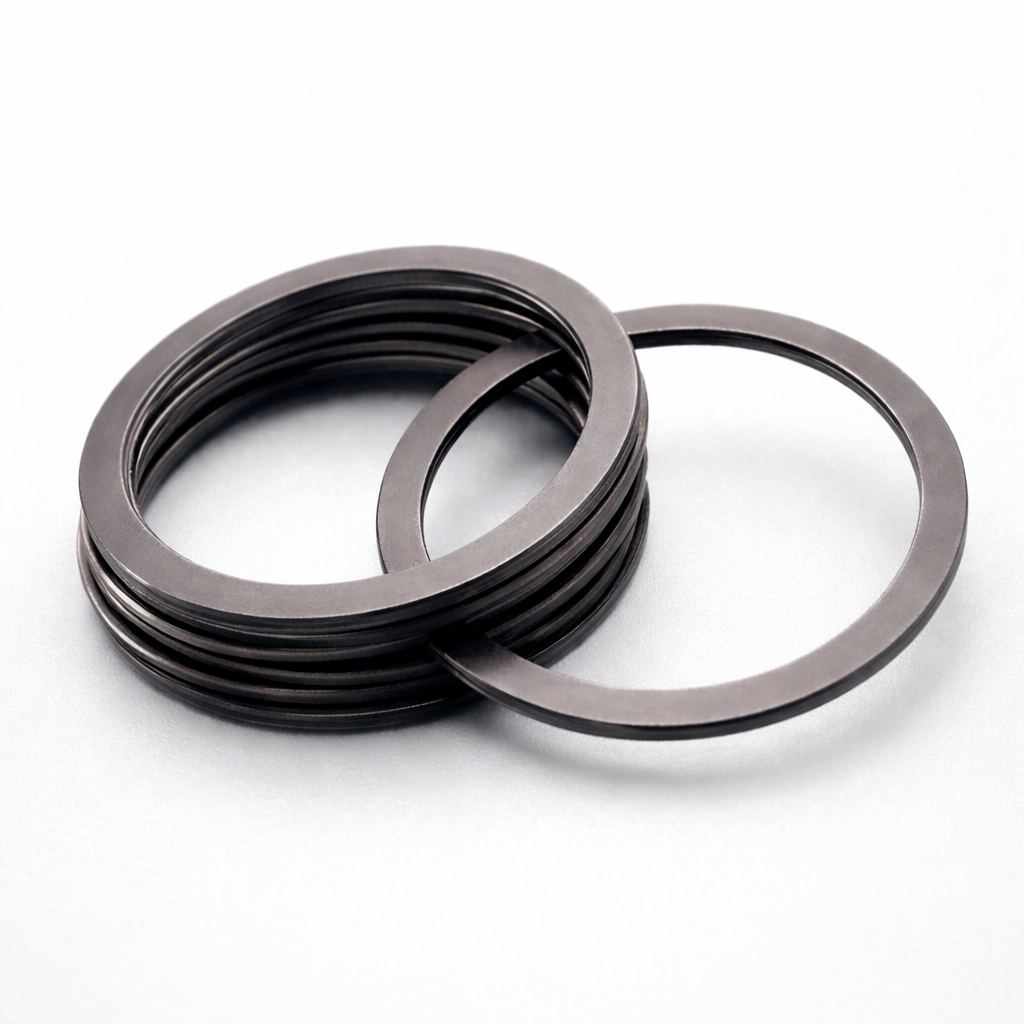
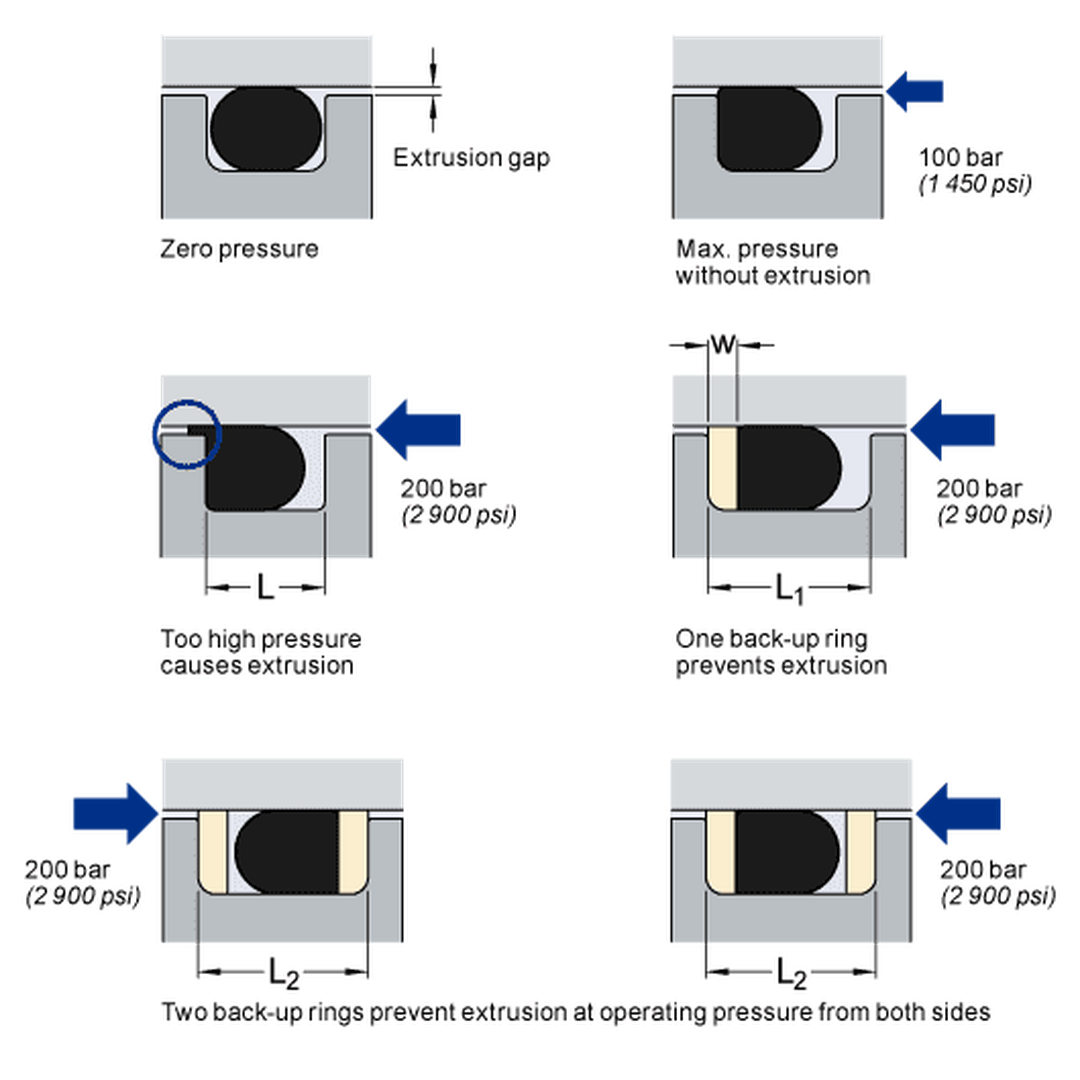
Backup rings are rigid or semi-rigid sealing support components installed alongside primary seals such as O-rings, X-rings or similar sealing elements. Their main job is to prevent the primary seal from extruding into the clearance gap between mating surfaces when the system is exposed to pressure. In high-pressure conditions, a seal without backup support can deform, nibble or even fail completely, especially when the groove design, material softness or pressure cycling increases the extrusion risk.
In practical sealing design, backup rings are not treated as a replacement for the primary seal. Instead, they work as a protective support element that helps the primary seal perform more effectively. This is why they are widely used in systems where pressure stability, leak prevention and service life are critical.
Why Choose Backup Rings?
Backup rings are chosen when the sealing system needs additional resistance to extrusion and greater stability under pressure. They become especially valuable in applications where the primary seal is exposed to high pressure, fluctuating load, large extrusion gaps or repetitive motion. In these cases, the backup ring helps preserve the shape of the seal and prevents damage that would otherwise reduce reliability.
They also allow engineers to use primary seal materials based on chemical compatibility or temperature performance without sacrificing mechanical protection. This is important because the best material for sealing media may not always be the best material for resisting extrusion. By adding a backup ring, the designer gains more flexibility in balancing performance factors.
Another important reason for choosing backup rings is maintenance reduction. A well-selected backup ring can help extend seal life, reduce repair frequency and improve the overall reliability of the equipment. That makes them especially useful in systems where downtime is expensive or difficult to manage.
Basic Design Elements of backup rings
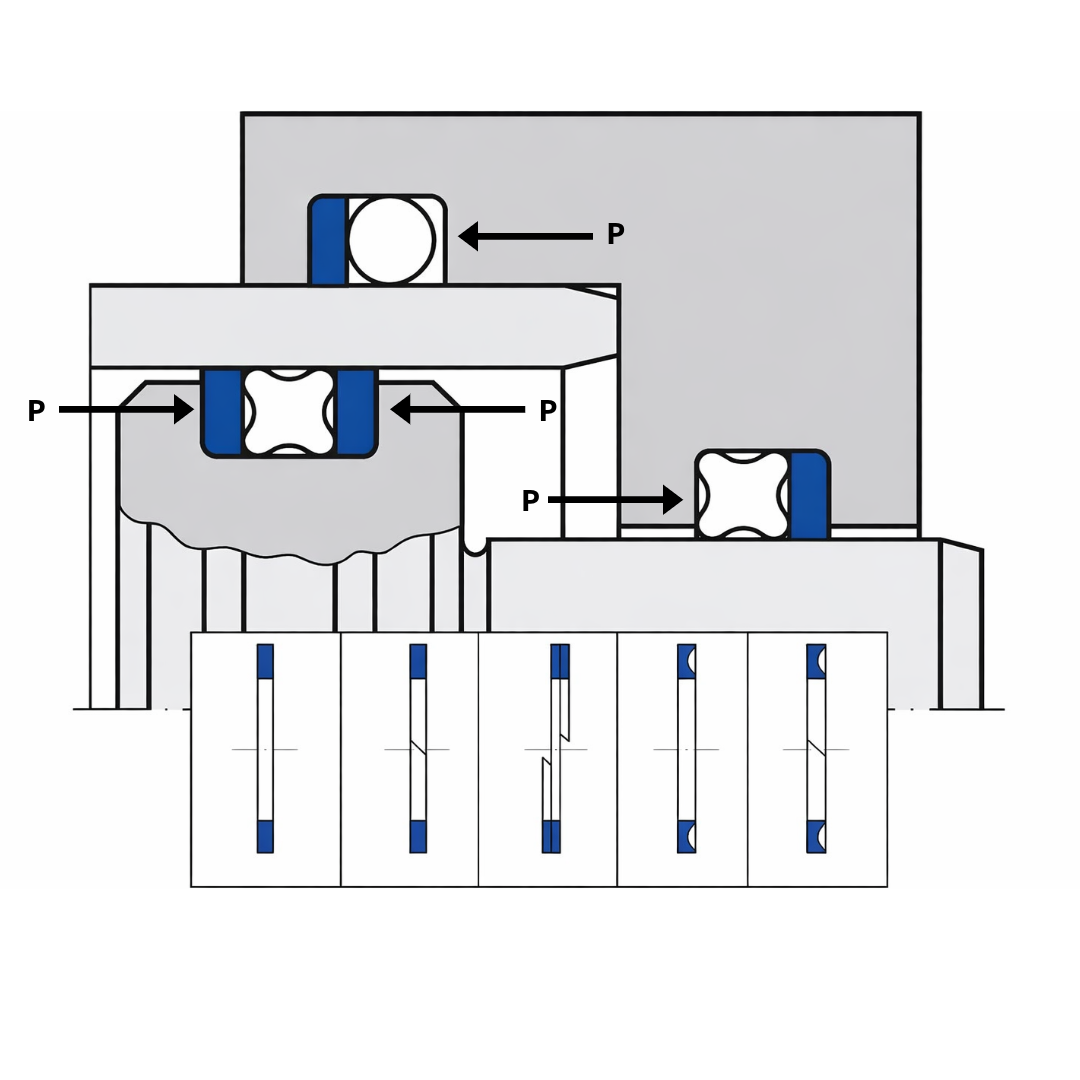
➤ The design of a backup ring depends on how the seal system is built and how pressure acts on the seal. One of the most important design distinctions is between external sealing and internal sealing. External sealing is typically associated with piston-style applications, while internal sealing is typically associated with rod-style applications. The ring must be selected according to the direction of pressure and the geometry of the sealing gland.
➤ Another key design element is the ring profile. Backup rings are not all shaped the same way. Rectangular profiles offer a simple and robust support form, while concave profiles are shaped to work more closely with the primary seal profile. Spiral profiles are used where flexibility during installation is important. The choice of profile affects both performance and assembly convenience.
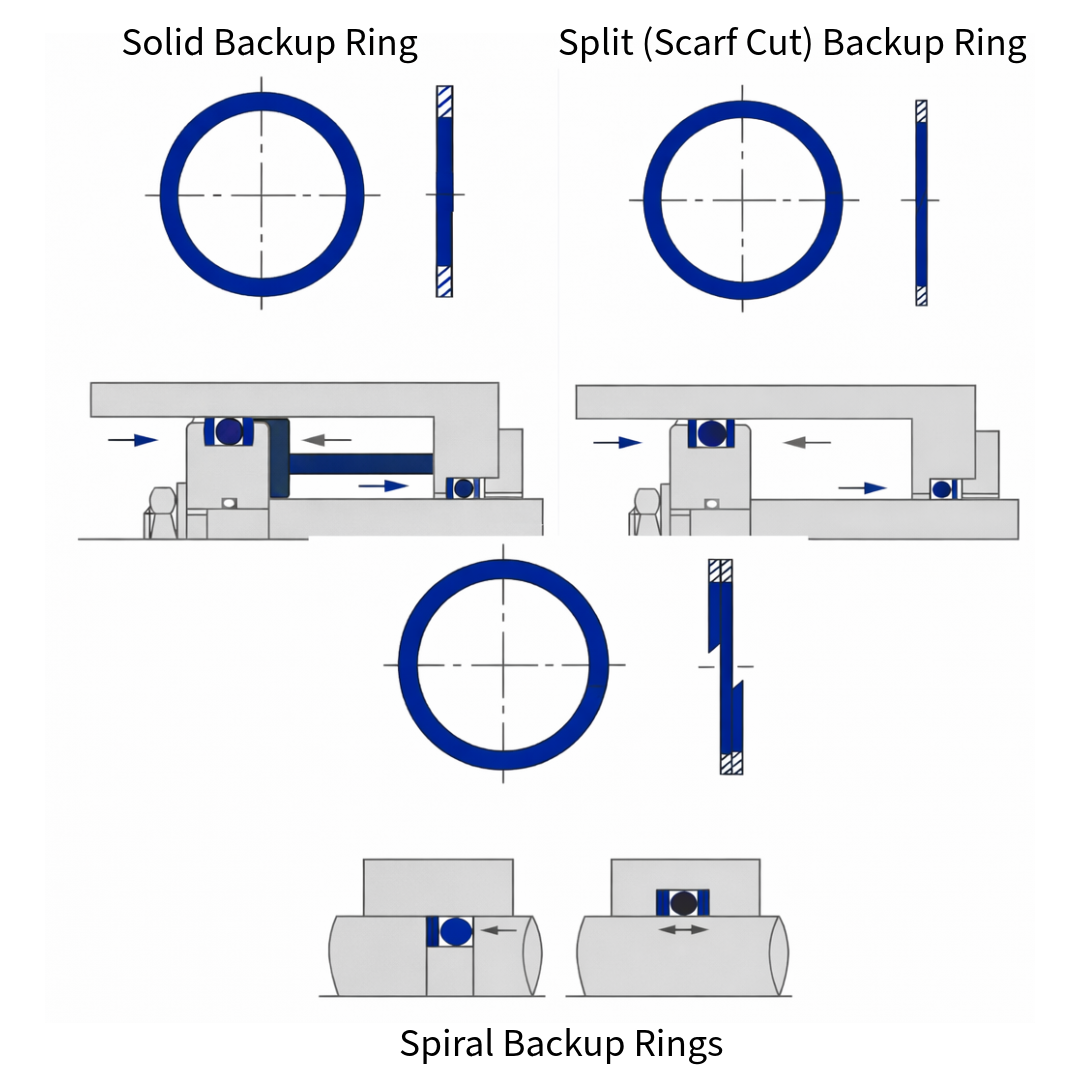
➤ The ring is also defined by whether it is supplied as a solid or cut version. Solid rings offer continuous anti-extrusion support, while cut rings are easier to install in assemblies where the groove does not allow a closed ring to be fitted easily. These differences are essential because the wrong design can reduce sealing effectiveness even if the material is correct.
Backup Ring Material Specifications
Material selection is one of the most important parts of backup ring design. The most commonly used family is PTFE because it combines low friction, excellent chemical resistance and strong dimensional stability. These properties make PTFE suitable for severe sealing conditions where the ring must resist deformation while staying compatible with the surrounding media.
Virgin PTFE is typically used when wide chemical compatibility and low friction are the main priorities. Filled PTFE grades are used when the application needs more rigidity, better wear resistance or stronger load-bearing behavior. Glass-filled PTFE improves stiffness and helps the ring retain its shape under pressure. Bronze-filled PTFE is chosen where mechanical support and dimensional stability are important. Carbon-filled or graphite-filled PTFE is useful where wear resistance and dynamic behavior need improvement.
In addition to PTFE-based grades, elastomeric materials such as NBR, HNBR, FKM and FFKM can also be used for certain backup ring or support ring designs depending on the sealing system and service conditions. These materials may be selected where flexibility, media resistance, temperature performance or compatibility with the primary seal is important. The final material choice should always be based on pressure, temperature, chemical exposure and the specific sealing application.
| Trade Name | Materials | Operating Temperature | Hardness ( Shore A ) |
|---|---|---|---|
| Novum P | PTFE (virgin) - Standard | -250°C to +250°C | 50 (Min) |
| Novum M | Modified PTFEs (TFMs) | -150°C to +260°C | 55±5 |
| Novum MOF 01 | 25% Glass Fiber + 5% Molybdenum Disulphide Filled PTFE | -200°C to +260°C | 60-65 |
| Novum MOF 02 | 15% Glass Fiber + 5% Molybdenum Disulphide Filled PTFE | -200°C to +260°C | 60±5 |
| Novum CF | Carbon Filled PTFE | -200°C to +250°C | 65 |
| Novum GF | Glass-Filled PTFE | -150°C to +250°C | 60±5 |
| Novum GC | Glass and Carbon Filled PTFE | -200°C to +260°C | 60±5 |
| Novum BF | Bronze-Filled PTFE | -150°C to +250°C | 60±5 |
| Novum CN | Copper Nickel PTFE | -150°C to +250°C | 60±5 |
| Novum PK | PEEK | +250°C Continuous | 80 |
| Novum PKC | PEEK Composite | +250°C Continuous | 75-85 |
| Vertex FC | FKM | -20°C to +230°C | 90±5 |
| Vertex F | FFKM | -40°C to +315°C | 90±5 |
| Vertex H | HNBR | -52°C to +160° | 90±5 |
| Cerulean N | NBR | -55°C to +135°C | 90±5 |
Back-up Ring Types
1) Solid and Split (Scarf Cut) backup rings
Backup rings can be supplied in Solid and Split (Scarf Cut) form. Solid rings provide continuous support and are preferred when the application demands the highest level of anti-extrusion protection. Split (Scarf Cut) rings are easier to fit into closed or restricted glands and are often used where installation simplicity is important. The choice between them depends on the hardware design and the service requirements.
2) Spiral backup rings
Spiral backup rings are used where installation flexibility matters. They can be useful in assemblies that are difficult to access or where a solid ring would be hard to install without special tooling. Their design gives the installer more freedom while still providing the anti-extrusion function required by the system.
3) Concave backup rings
Concave backup rings are shaped to work more closely with the seal geometry. They may help distribute load more effectively in certain gland designs and can be a better fit where the pressure response needs to be more controlled. Their shape gives designers another option when a standard form is not the best match.
Need Backup Rings Engineered for Pressure, Heat and Seal Stability?
Contact ISMAT for technical guidance and custom backup ring solutions built to support critical industrial sealing performance.
How backup rings work
When pressure rises, the primary seal can be forced toward the low-pressure side and into the extrusion gap. The backup ring acts as a rigid or semi-rigid support element that blocks this movement and keeps the seal in its correct working position. This helps reduce deformation, nibbling and premature seal damage.
Backup rings are especially important in systems where pressure spikes, repeated cycling or large clearances can shorten seal life. In many designs, a single backup ring is used on the downstream side of the seal when pressure acts from one direction. In bi-directional pressure systems, two backup rings are used, one on each side of the seal, to provide protection in both directions.
Installation Guidance for Backup Rings
➤ Prepare the groove carefully before installation. The groove and mating surfaces should be clean, smooth and free from burrs or sharp edges because surface defects can damage the backup ring or the primary seal.
➤ Position the backup ring on the correct pressure side. If it is installed on the wrong side of the seal, it will not protect the area where extrusion risk is highest.
➤ Match the ring type to the assembly method. Cut rings are easier to install in restricted assemblies, while solid rings are better where the design allows continuous placement.
➤ Handle the ring with care during assembly. Twisting, nicks or poor seating can reduce its anti-extrusion support and shorten seal life.
➤ Treat installation quality as part of the sealing design. Even a correct material choice can underperform if the ring is damaged or fitted incorrectly.
Industries and applications of backup rings
Backup rings are used wherever seals operate under conditions that threaten extrusion or premature wear. One of the most common application areas is hydraulics, where cylinders, actuators and pumps experience repeated loading and pressure fluctuations. In these systems, backup rings help the seal survive long service cycles and maintain stable performance.
They are also important in valve systems, pressure-control assemblies, compressors and industrial machinery. In these environments, the sealing system may be exposed to pressure spikes, varying load and restricted assembly space. Backup rings help maintain seal shape and reduce the risk of leakage-related failure.
Common application areas include:
➤ Hydraulic cylinders and actuators.
➤ Valve stems and valve seats.
➤ Pumps and compressors.
➤ Pressure-control systems.
➤ Industrial machinery and heavy equipment.
➤ High-load sealing assemblies with large clearance gaps.
Advantages of using backup rings
The main advantage of a backup ring is extrusion resistance. By supporting the primary seal, it reduces the chance that the seal will deform into the clearance gap under pressure. This leads to better seal retention and longer operating life.
Backup rings also improve reliability in systems that must perform under variable conditions. Pressure spikes, cycling loads and long service intervals all become more manageable when the seal has structural support. In many cases, this means fewer shutdowns, lower maintenance demand and more stable equipment performance.
Additional advantages include:
➤ Longer life of the primary seal.
➤ Better resistance to nibbling and extrusion damage.
➤ Greater stability under fluctuating pressure.
➤ Improved design flexibility for seal material selection.
➤ Reduced maintenance frequency.
➤ Higher reliability in critical systems.
Why Choose ISMAT for Backup Rings?
ISMAT focuses on backup rings as an engineered sealing component, not just a standard part. The priority is application fit, material selection and reliable performance in pressure-loaded systems where seal support matters.
With strong knowledge of high-performance sealing materials and custom manufacturing capability, ISMAT can support backup ring requirements across demanding industrial applications. That makes it easier to match the right ring to the right sealing condition and improve overall system reliability.
Applications of Backup Rings




Trusted by Industry Leaders




Get In Touch
Contact ISMAT for Backup Rings
For sealing systems where performance cannot be compromised, choose backup rings engineered for precision and reliability.
Contact ISMAT for application-specific backup ring solutions designed to support your most demanding operating conditions.
FAQs
A backup ring supports the primary seal and helps prevent extrusion into the clearance gap under pressure. It improves sealing stability and extends seal life in demanding applications.
Backup rings should be used when the sealing system is exposed to high pressure, pressure spikes or larger extrusion gaps. They are also useful when the primary seal material needs additional mechanical support.
PTFE and filled PTFE grades are the most common materials because they offer low friction, chemical resistance and good dimensional stability. In some applications, other engineering polymers may also be used based on operating conditions.
Yes, backup rings can be used in both static and dynamic sealing systems. The exact design and material must be selected based on pressure direction, motion, groove design and operating conditions.