

In the high-stakes world of industrial manufacturing, a single component often stands between seamless operation and a catastrophic system failure: the elastomer seal. While engineers frequently focus on a material’s hardness, chemical compatibility or temperature rating, there is one metric that quietly determines long-term reliability – “compression set”.
If you have ever wondered why a high‑quality O‑ring start leaking after months of perfect service, the answer is often this: the seal has lost its ability to “push back” against the hardware. Visualizing compression set as the silent memory loss of your seals makes it easier to understand why it is not just a laboratory curiosity, but a critical design and maintenance decision for any industrial plant.
What Really Happens Inside the Seal?
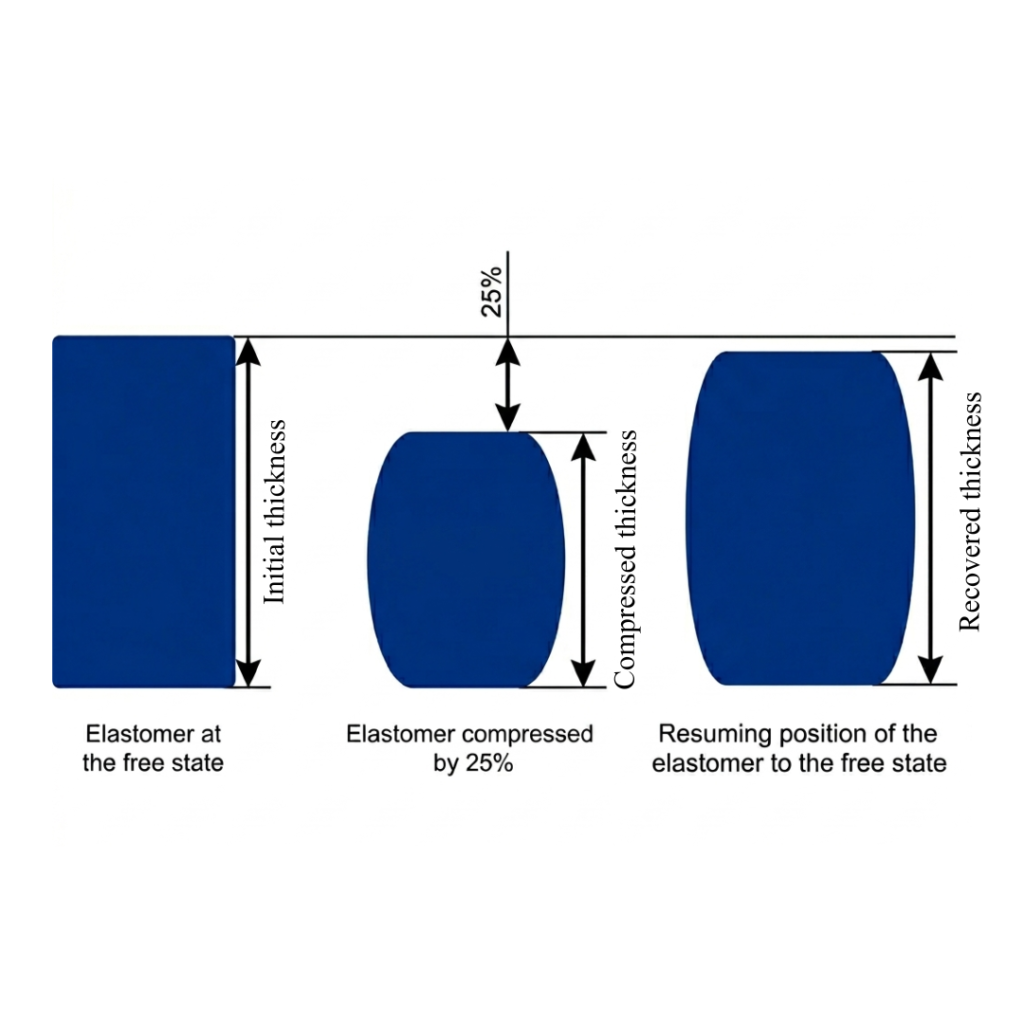
At its core, the compression set is the permanent change in shape that remains in an elastomer after it is compressed and then released. Imagine a rubber gasket squeezed between two metal flanges for months or even years. When the flanges are finally separated, the ideal result is that the gasket returns to its original thickness. In reality, many rubber materials stay slightly flattened or distorted and do not fully spring back.
This leftover deformation is expressed as a percentage of how much the seal was originally compressed. A 0% compression set means the material recovers completely, like a perfectly elastic band. A 100% compression set means the material stays flat and has lost almost all of its ability to push back.
What many engineers overlook is that compression set is not just a single lab value; it is a living indicator of how the polymer chains inside the seal respond to long‑term stress and heat. The more those chains get locked in the compressed position, the more the seal weakens and loses its sealing power over time.
The Physics of Sealing Force and Seal Memory
An effective seal is not just about the initial installation; it is about the continuous sealing force it exerts against the mating surfaces. This back pressure is the reason O‑rings, gaskets and other elastomeric components remain leak‑tight.
Under sustained compression – particularly at elevated temperatures, molecular chains in the elastomer can break and reform in the compressed state. Some of these bonds never return to their original configuration, effectively erasing the seal’s “memory” of its uncompressed shape. As the material’s ability to rebound diminishes, so does the sealing force and leaks inevitably appear.
In high‑pressure or high‑temperature environments, this process is not just a matter of wear; it is a chemical and structural transformation of the sealing material.
How Compression Set is Measured: The ASTM D395 Standard
To ensure consistency across the industry, engineers rely on the ASTM D395 standard, which defines how compression set is measured. The two primary methods are:
● Method A – Constant Force: Measures compression set under a continuous load. This is typically used for vibration mounts and similar applications, but rarely for industrial seals.
● Method B – Constant Deflection: This is the industry standard for seals and gaskets. It simulates how a seal is installed in a metal groove, holding the specimen at a fixed percentage of its original height—usually 25% or 40% deflection—for a defined period in an oven.
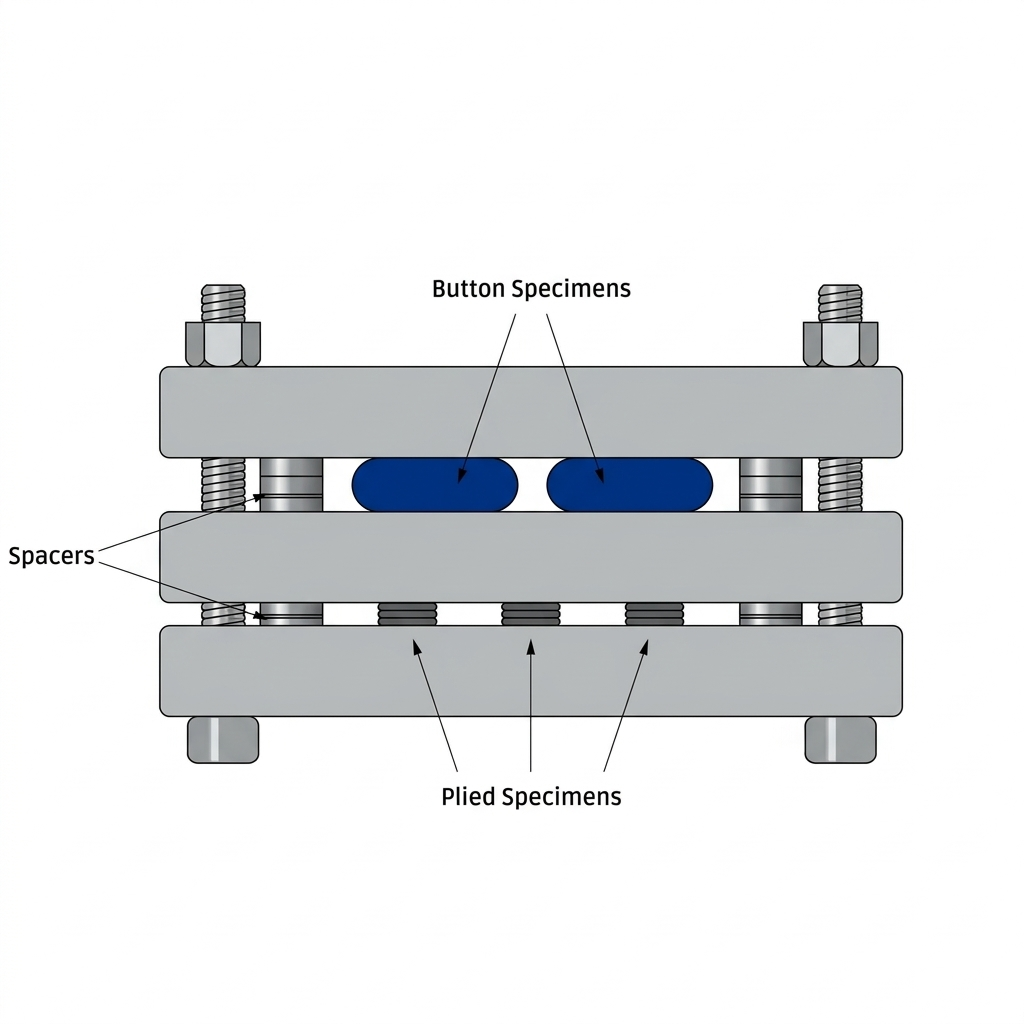
After the test duration (commonly 22 or 70 hours), the specimen is removed, allowed to recover for 30 minutes and then measured. The difference between the original thickness and the recovered thickness reveals the degree of permanent deformation.
The Mathematics Behind the Measurement
The compression set calculation quantifies this behavior in a way that allows engineers to compare different materials:
| Compression Set % = [(Initial Thickness − Final Thickness) /(Initial Thickness − Spacer Thickness)] × 100 |
This formula emphasizes that the compression set is not simply “how flat the seal is,” but rather how much recovery capability it has lost relative to its original compressed state. A lower percentage indicates a material that retains more of its elastic memory and therefore better long-term sealing performance.
Industries that use O‑rings and gaskets for critical applications often consider 20% or lower to be excellent for high‑performance sealing, while values exceeding 40% may signal unsuitability for demanding environments.
Material Families and Their Recovery Characteristics
Different elastomers exhibit vastly different compression set behaviors and understanding these differences is key to selecting the right material for the application.
FKM Variants
| Trade Name | Material | ASTM D 395 METHOD B | ASTM D 395 METHOD B | ASTM D 395 METHOD B |
|---|---|---|---|---|
| Compression Set 22hrs@200°C (Value in %) | Compression Set (Max) ( 70 hrs @ 24 ⁰C ) (Value in %) | Compression Set 70hrs@200°C (Value in %) |
||
| Vertex FC 09 | FKM | 12.90 | 16.11 | |
| Vertex FC 10 | FKM | 11.3 | 14.4 | |
| Vertex FC 11 | FKM | 18.47 | 23.75 | |
| Vertex FC 13 | FKM | 9.03 | 18.53 | |
| Vertex FC 14 | FKM | 9.62 | 13.02 | |
| Vertex FC 15 | FKM | 12.90 | 16.98 | |
| Vertex FC 15A | FKM | 10.29 | 18.35 | |
| Vertex FC 16 | FKM | 6.84 | 12.91 | |
| Vertex FC 16A | FKM | 17.46 | 25.40 | |
| Vertex FC 18 | FKM | 22.71 | 31.25 | |
| Vertex FC 24ULT | FKM | 8.39 | 16.13 | |
| Vertex FC 33 | FKM | 7.82 | 12.05 |
FFKM Variants
| Trade Name | Material | ASTM D 395 METHOD B | ASTM D 395 METHOD B | ASTM D 395 METHOD B | ASTM D 395 METHOD B | ASTM D 395 METHOD B |
|---|---|---|---|---|---|---|
| Compression Set (Max) ( 22 hrs @ 200 ⁰C) (ORING) (Value in %) | Compression Set (Max) ( 22 hrs @ 250 ⁰C) (ORING) (Value in %) | Compression Set 24hrs@200°C (Value in %) | Compression Set 70hrs@200°C (Value in %) | Compression Set (Max) ( 70 hrs @ 250 ⁰C) (ORING) (Value in %) |
||
| Vertex F 01ED | FFKM | 30 (Max) | ||||
| Vertex F 02 | FFKM | 30 (Max) | ||||
| Vertex F 02LT | FFKM | 20.00 | ||||
| Vertex F 03HT | FFKM | 25 (Max) | ||||
| Vertex F 04HT | FFKM | 35 (Max) | ||||
| Vertex F 05 | FFKM | 30 (Max) | ||||
| Vertex F 06HT | FFKM | 25 (Max) | ||||
| VERTEX F 07LT | FFKM | 30 (Max) | ||||
| VERTEX F 09M | FFKM | 30 (Max) | ||||
| VERTEX F 10M | FFKM | 30 (Max) | ||||
| VERTEX F 16 | FFKM | 17.02 | 27.22 | 18.09 | 39.44 |
HNBR Variants
| Trade Name | Material | ASTM D 395 METHOD B | ASTM D 395 METHOD B | ASTM D 395 METHOD B | ASTM D 395 METHOD B |
|---|---|---|---|---|---|
| Compression Set 22hrs@100°C (Value in %) | Compression Set 70hrs@100°C (Value in %) | Compression Set 22hrs @150°C (Value in %) | Compression Set 70hrs @150°C (Value in %) |
||
| Vertex H 16LT | HNBR | 25 (Max) | 35 (Max) | ||
| Vertex H 17 | HNBR | 9.52 | 18.77 | ||
| Vertex H 18 | HNBR | 25 (Max) | 35 (Max) | ||
| Vertex H 18LT | HNBR | 14.92 | 24.84 |
Each of these materials offers a unique balance between performance, cost and service life and compression set is one of the most reliable indicators of how well that balance is maintained over time.
Environmental Factors That Accelerate Failure
Compression set is not an inherent property; it is heavily influenced by the service environment.
● Temperature: Heat is the primary accelerator of compression set. Higher temperatures increase the mobility of polymer chains, making them more likely to re‑form in the compressed state and permanently lose thickness.
● Time: The longer a seal remains under load, the more pronounced the compression set becomes.
● Chemical Exposure: Incompatible fluids can cause volume swell or degrade the polymer network, further reducing the seal’s ability to rebound.
Practical Strategies for Industrial Operations
To mitigate the risk of seal failure in your facility, consider the following actionable steps:
● Specify by Application: Do not rely on generic “good for sealing” labels. Instead, request compression set data that matches your actual operating temperature and duration.
● Audit Gland Design: Ensure groove dimensions and squeeze percentages are consistent with recommended engineering practices to avoid over‑stressing the material.
● Prioritize Proper Cure: Ensure seals are fully vulcanized. A post‑cure process can significantly improve a material’s recovery performance, extending its service life.
Prioritize Compression Set in Your Sealing Strategy—Partner with ISMAT for Engineered Elastomer Solutions
In industrial sealing, compression set is a hidden but critical factor in reliability. It often goes unnoticed during commissioning, only revealing itself months or years later as a gradual rise in leakage, increased maintenance calls or unplanned shutdowns. By understanding how this property is measured through the ASTM D395 standard and prioritizing low compression set elastomers, you can dramatically extend the service life of your equipment and avoid the costly consequences of unexpected leaks.
Compression set is not just a technical metric; it is a design philosophy. It reminds us that the true performance of a seal is not how it looks at installation, but how it behaves over time under the stresses of real‑world operation. Choosing the right elastomers based not only on basic properties such as hardness and temperature range, but also on their ability to retain shape and sealing force under prolonged load and fluctuating conditions, is what separates short‑term, reactive seal replacement from long‑term, strategic sealing‑system design.
For manufacturers like ISMAT, with decades of experience in high‑performance sealing solutions, controlling compression set is at the heart of the value proposition. ISMAT’s in‑house compound development, such as the Vertex elastomer series, is explicitly engineered to deliver low compression set, excellent rebound and long‑term sealing integrity in demanding Oil & Gas, energy, hydrogen and general‑industry applications. By combining precise material design, rigorous testing and deep application know‑how, ISMAT turns compression set from a risk factor into a competitive advantage – ensuring that the seals protecting your systems remain the silent heroes of your operations, not the hidden causes of failure.
Get In Touch
Contact Us
Compression set is not just a material property - it is a critical design factor in industrial sealing performance.
Partner with ISMAT to select the right low compression set elastomers, engineering plastics and custom sealing solutions engineered to meet your exact operating conditions and global industry standards.
