
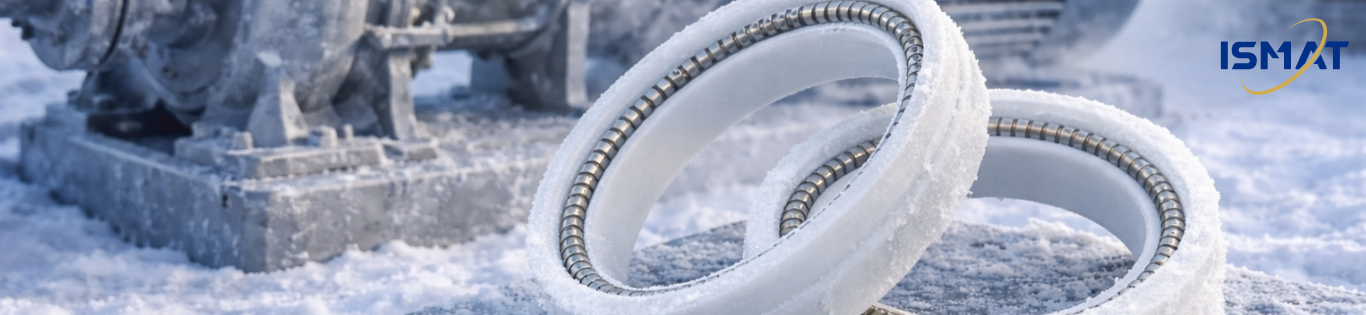
In high-pressure oil and gas operations, reliable sealing solutions are an operational requirement. From deepwater exploration to high-temperature processing facilities, equipment endures extreme pressures, temperature fluctuations, and corrosive chemicals. Sealing failures can cause devastating outcomes like equipment damage, environmental spills, costly production halts and potential loss of life— creating the need for advanced sealing technologies to uphold safety, efficiency and compliance across upstream and downstream activities.
In this blog, we explore how spring-energized PTFE seals replace O-rings in low-temperature oil and gas applications.
Limitations of Rubber O-rings in Low-Temperature Oil & Gas Applications
In oil and gas applications, when temperatures drop to extreme low, conventional O-rings turn brittle, experience reduced elasticity and crack under load. Permanent deformation risks escalate, opening leak paths through critical barriers. Standard elastomers like: EPDM, Silicone, CR & NBR are chemically incompatible with methane and FKM is particularly incompatible with LNG at -162°C – leading to swelling and O-ring failures.
At ISMAT, we recommend spring-energized PTFE seals for these conditions. These proven solutions maintain sealing integrity where traditional O-rings cannot deliver reliable performance in low-temperature environments.
An Introduction to Spring Energized Seals
Spring-energized seals is essential in the oil and gas sector, made of a PTFE jacket and integrated with a metal energizer to ensure reliable sealing under extreme conditions. These seals expand the performance limits of polymer seals, addressing the most demanding operational requirements with pressures up to 25,000 psi. The following outlines their key advantages.
1. Low-Temperature Resistance
Spring-energized seals deliver reliable sealing performance across extreme temperatures, from as low as -162°C in cryogenic LNG processes to over 250°C in high-temperature steam injection. The virgin or filled PTFE jacket— possesses a low coefficient of thermal expansion—resists embrittlement in subzero conditions and creep deformation at elevated temperatures, eliminating the glass-transition failures common in elastomeric alternatives and ensuring continuous uptime in thermal cycling operations.
2. High-Pressure Reliability
Precision-engineered for differential pressures from control valves to wellhead completions; these seals deliver unmatched stability across low and high-pressure applications. Proprietary filled PTFE formulations, including 15-40% glass carbon or bronze dispersions, enhance tensile modulus and extrusion resistance, sustaining zero-gap integrity in clearances as narrow as 0.005 inches even under dynamic cycling—critical for reducing unplanned shutdowns and extending mean time between failures (MTBF) in high-stakes environments.
3. Exceptional Chemical Resistance
These seals demonstrate superior inertness to the oilfield’s most aggressive media, including sour gas (H₂S >10% vol), acid gases, CO₂-supersaturated brines and methanol injection streams, validated through NACE TM0187-2011 and NACE TM0192-2012 certifications. The corrosion-resistant energizing spring preserves radial preload and seal geometry against chemical swelling or erosion, maintaining contact pressure and leak-tight performance over extended service intervals, thereby minimizing corrosion-related integrity risks and associated remediation costs.
4. Effective Fugitive Emission Management
In an era of stringent API 6A and ISO 9001:2015 regulatory frameworks, these seals deliver robust leak-tight containment in valves, actuators and rotary equipment. By compensating for wear, thermal mismatch and media-induced degradation, they ensure operational compliance, prevent non-productive time from emission-related derates and strengthen ESG performance metrics for upstream and midstream operators.
Spring Types in Spring-Energized Seals for Oil & Gas Applications
Spring-energized seals leverage four proven spring configurations, each tailored to the rigorous demands of oil and gas operations including cryogenic LNG service, high-pressure wellhead completions, subsea actuators and sour gas environments. These designs ensure reliable sealing under thermal extremes, pressure differentials and media aggression.
1. Garter Springs
Garter springs utilize a coiled wire construction that resists axial extension, ensuring reliable radial sealing in shaft applications. In oil and gas, they are widely deployed in downhole pumps and rotary equipment to accommodate shaft runout prevalent in drilling operations. Their adaptable sizing supports broad seal dimensions and independent operation without an opposing surface makes them ideal for contaminated service conditions.
2. Cantilever (V) Springs
Cantilever or V – springs feature a formed metal strip in a V geometry, providing extensive deflection capability and concentrated loading at the seal’s leading edge. Oil and gas operators specify them for reciprocating subsea actuators, valve scrapers and applications with tolerance variations or gland misalignment, such as blowout preventers and wellhead gates. They effectively exclude abrasives like sand in hydraulic fracking and offshore systems.
3. Helical-Wound Springs
Helical-wound springs consist of metal strip coiled into a helix, generating high initial load within a compact profile. They are the preferred choice for static cryogenic LNG valves and vacuum-rated wellhead penetrations. Suitable for low-cycle dynamic service, these springs demand precise alignment to maximize effectiveness in temperature-controlled installations.
4. Canted-Coil Springs
Canted-coil springs employ round wire in a slanted coil pattern, maintaining stable load across varying engagement levels. In oil and gas, they are essential for gate valve stems, dynamic actuators and misaligned glands on offshore platforms or in sour gas pipelines. Their low-friction profile ensures durability in high-cycle operations, minimizing wear and supporting extended maintenance intervals.
How ISMAT’s PTFE Series Spring-Energized Seals Work
ISMAT’s PTFE spring-energized seals integrate a precision-engineered PTFE jacket with a corrosion-resistant metal spring energizer, providing reliable dynamic sealing in extreme oil & gas environments.
Installed in the seal gland, the energizer spring delivers continuous radial force to form a leak-proof contact line against mating surfaces. This mechanism compensates for jacket wear, thermal expansion, pressure variations and gland tolerances, ensuring consistent sealing performance over the service life.
Jacket sealing lips are machined from ISMAT’s proprietary Novum PTFE materials—virgin Novum P 01 (50 Shore A min, -250°C to +250°C), modified Novum M 03 (55±5 Shore A, -150°C to +260°C), 15% glass-filled Novum GF 01 (55-65 Shore A, -200°C to +260°C), 20% carbon-filled Novum CF 02 (60 Shore A min, -200°C to +250°C) and Novum GC 01 (10% glass + 15% carbon, 60 Shore A min, -200°C to +260°C)— all mentioned variants are API 6A certified for sour service (10% H₂S at 200°C).
PTFE Series products accommodate customizable energizer types including V-spring, C-spring and helical coil, tailored for low-friction dynamic, Low-Temperature or high-load applications in valves, pumps, compressors and downhole equipment.
Upgrade to ISMAT Spring-Energized Seals for Oil & Gas
ISMAT’s Novum seires PTFE materials – all API 6A certified for sour gas (10% H₂S at 200°C) provide tensile strengths of 10-25 MPa, elongations from 80-300% and minimal deformation under load, ensuring superior sealing reliability. These spring-energized seals eliminate O-ring failures in cryogenic LNG systems, high-pressure wellheads and corrosive sour gas environments.
Contact ISMAT today to deploy proven technology that delivers leak-free performance, regulatory compliance and maximum operational uptime.
Get In Touch
Secure Your Low-Temperature Oil & Gas Operations with ISMAT Seals
As an autonomous producer, we rank among India's top providers of high-precision seals
Replace brittle O-rings with ISMAT's API 6A-certified Novum PTFE spring-energized seals engineered for LNG cryogenic service, extreme pressures and sour gas resistance in valves and actuators.
